

Think about the last time you walked across a parking lot. Did you move with purpose, or did you shuffle? Did people pass you? Did you notice yourself slowing down on the way back to the car?
Most of us never think about how fast we walk. It’s automatic. But researchers have started paying very close attention to it, because walking speed turns out to be one of the most revealing numbers about how you’re aging, including what’s happening inside your brain.
I’m not telling you this to scare you. I’m telling you because walking speed is one of the few health markers you can measure in your own hallway, and one of the few you can actually improve, starting this week.
If you’ve been told that slowing down is just part of getting older, I want to push back on that. Some change is normal. But a lot of what we blame on age is really the result of years of sitting more and moving less. That part is reversible.
Why Walking Speed Is a Window Into Your Brain
Walking feels simple, but it isn’t. Every step requires your brain to coordinate balance, muscle timing, vision, attention, and planning, all at once. When any part of that system starts to slip, your stride is often one of the first places it shows up.
In 2020, Dr. Qu Tian and colleagues at the National Institute on Aging published a large study in JAMA Network Open that pulled together data from six long-running studies, covering 8,699 adults over 60. They tracked two things over time: memory and walking speed.
People whose walking speed declined had about 2.2 times the risk of developing dementia compared with people who stayed steady. Those whose memory declined had about 3.5 times the risk. But people who lost both, memory and gait speed together, had a risk more than six times higher.
Let me be clear about what that means. A slower walk doesn’t cause dementia, and a slow day doesn’t mean anything is wrong with you. But a steady slowdown over months and years is a signal worth paying attention to, and something worth mentioning to your doctor.
Why would memory and walking slip together? Researchers think it’s partly because both rely on overlapping brain networks, especially the ones that handle attention and planning. When those networks are under strain, thinking and walking can suffer at the same time. That’s why scientists increasingly treat walking speed like a vital sign for the aging brain.
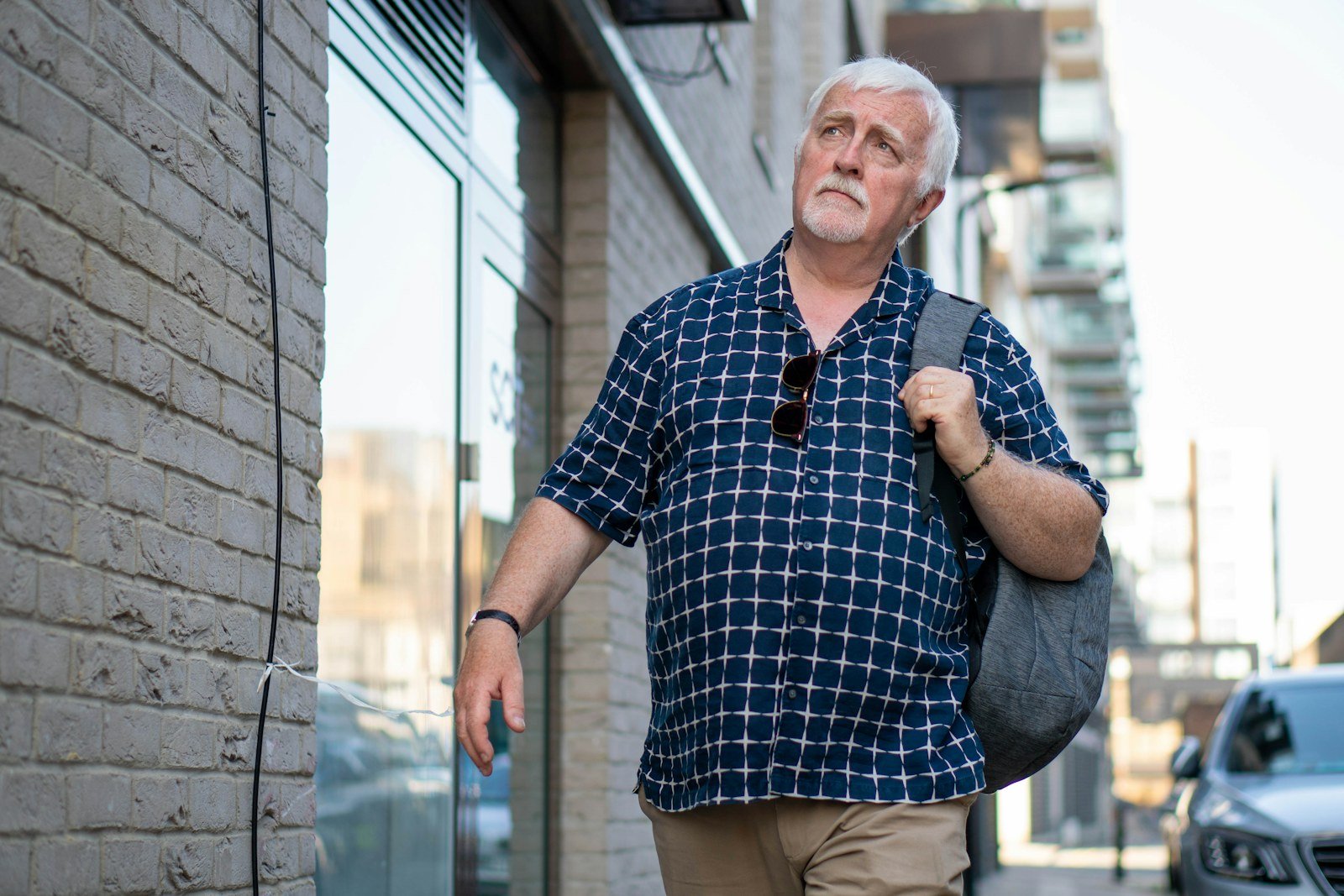
What Your Walk Says About the Years Ahead
Walking speed doesn’t just track your brain. It tracks your whole body. In 2011, Dr. Stephanie Studenski and a team of researchers pooled data from nine studies and more than 34,000 adults aged 65 and older, publishing their results in JAMA.
They found that walking speed was strongly tied to how long people lived. Adults who walked at about one meter per second or faster consistently lived longer than you’d predict from their age and sex alone. That’s roughly 3.3 feet every second, a comfortable but purposeful pace.
Why would something so ordinary predict so much? Because walking speed is a summary of everything working together: your heart, lungs, muscles, joints, nerves, and brain. When your walk is strong, it usually means those systems are still talking to each other well.
Some doctors and physical therapists now time patients’ walks for exactly this reason. It takes under a minute, costs nothing, and can say more than many expensive tests. If yours has never done it, you can ask.
You don't have to walk fast today. You just have to walk today. Speed comes back to the people who keep showing up.
When I hit my early 60s and realized I’d lost real muscle, one of the first things I noticed was how I walked. I felt it on stairs, on hills, crossing busy streets. That was my wake-up call. It wasn’t a scan or a blood test. It was the way my own legs carried me.
So I did what I tell everyone else to do. I started small. Short walks around my neighborhood. Leg work at angles that didn’t light up my shoulders or knees. Some days it felt pointless. But week by week, the stairs got easier, the hills got shorter, and my stride came back. Not because I was motivated every day, but because I kept going on the days I wasn’t.

The Good News: Walking Can Help Rebuild Your Brain
Here’s the part that should get you off the couch. The connection runs both directions. Walking more doesn’t just reflect a healthier brain. It may help build one.
In a well-known trial led by Dr. Kirk Erickson and published in the Proceedings of the National Academy of Sciences in 2011, researchers took 120 sedentary older adults without dementia and split them into two groups. One group walked for 40 minutes, three days a week, for a year. The other did stretching and toning.
After a year, the walkers’ hippocampus, the part of the brain central to memory, grew by about 2 percent. The stretching group’s hippocampus shrank by about 1.4 percent, which is roughly what you’d expect with normal aging. The walkers also improved on a memory test, and their gains were linked to higher levels of BDNF, a protein that helps brain cells grow and connect.
Think about that. These weren’t athletes. They were people who weren’t exercising at all. They didn’t run marathons. They walked, consistently, for a year, and their brains responded.
The shrinkage in the stretching group matters too. It shows what happens when we simply let time do its thing. Doing nothing isn’t neutral. Your brain, like your muscles, responds to how you use it, and the volunteers in that study were already older adults when they started. The window doesn’t close at 60 or 70.
How to Test and Train Your Walking Speed at Home
You don’t need a lab to check your pace. You need a hallway, a tape measure, and a phone with a stopwatch. Here’s a simple way to do it safely:
- Measure out about 10 feet in a clear, well-lit hallway or driveway, and mark the start and finish with tape. Give yourself a few extra steps before and after so you’re at full pace through the measured section.
- Walk at your normal, comfortable speed. Don’t race. Time how long it takes to cover the 10 feet. Roughly 3 seconds or less puts you near that one-meter-per-second mark.
- Write the number down, then test again every month. One number means very little. A trend over time tells you something real.
- If you notice a steady decline, or you feel unsteady during the test, bring it up with your doctor. That conversation is worth having early.
Now let’s train it. Walking speed improves the same way everything else improves: steady, repeatable work.
- Start with 10 minutes a day, most days of the week. If that’s too much, start with 5. You do not need to match the 40 minutes from the research on day one. Build toward it.
- Add short pickups. During your walk, try 30 seconds at a slightly quicker pace, then ease back. Repeat a few times. This teaches your body to move with purpose again.
- Strengthen your legs. Sit-to-stand from a sturdy chair, gentle step-ups, and resistance-band leg work all build the hip and thigh strength that drives your stride.
- Challenge your brain while you walk. Once you’re steady, try naming animals alphabetically or counting backward by threes on a safe, familiar route. Walking and thinking together is exactly the skill that declines with age.
- Walk with someone. A partner keeps you consistent, and conversation is its own kind of brain training.
Give yourself eight to twelve weeks before you judge your results. Bodies over 50 adapt, but they adapt on their own schedule. Retest your hallway time once a month and celebrate every fraction of a second. Those small gains are your muscles, nerves, and brain relearning to work as a team.
If your joints complain, slow the pace, shorten the route, and pick flatter ground. Pain-free movement you can repeat beats heroic effort you can’t.
Your Next Step
If you’re thinking, that’s great, but I haven’t moved in years and I don’t know where to start, I built something for exactly where you are. The 5-Day Fit & Strong Reset is a free, beginner-friendly PDF with five short sessions using just a resistance band. It’s designed to wake up the leg and hip strength that powers your walk, without punishing your joints.
And if you’re not feeling motivated? That’s normal. The only way to start when you’re not motivated is to do it anyway. Download the Reset, do day one, and let the momentum build from there.
Visit SilverFitPlus.com to get your free copy of the 5-Day Fit & Strong Reset today.
Already comfortable in the gym and ready for a structured plan? Check out Build Strong After 50, my 12-week strength program designed specifically for adults over 50.
This article is for general education and isn’t medical advice. If you notice changes in your memory or walking, or feel unsteady on your feet, talk with your doctor.
Free 5-Day Guide
Get the Free 5-Day Fit & Strong Reset
A joint-safe, beginner-friendly start for adults over 50. Enter your email and the guide goes straight to your inbox.
No spam. Unsubscribe anytime.
Sources
- Tian Q, Resnick SM, Mielke MM, et al. — "Association of Dual Decline in Memory and Gait Speed With Risk for Dementia Among Adults Older Than 60 Years: A Multicohort Individual-Level Meta-analysis" — JAMA Network Open, 2020 — https://jamanetwork.com/journals/jamanetworkopen/fullarticle/2761549
- Studenski S, et al. — "Gait Speed and Survival in Older Adults" — JAMA, 2011 — https://jamanetwork.com/journals/jama/fullarticle/644554
- Erickson KI, et al. — "Exercise training increases size of hippocampus and improves memory" — Proceedings of the National Academy of Sciences, 2011 — https://pmc.ncbi.nlm.nih.gov/articles/PMC3041121