
Here’s something most people over 50 never get told: the slow loss of strength you feel — the jars that are harder to open, the stairs that leave you winded, the way you tire faster than you used to — often isn’t just “getting older.” A big piece of it is that you’re eating too little protein, at the wrong times, to hold onto the muscle you have.
After 50, muscle doesn’t just sit there waiting for you. You lose it steadily unless you give your body a reason to keep it. And the two biggest reasons are resistance training and protein. Let’s talk about the protein half — because it’s the part almost everyone gets wrong.
Why your muscles stopped listening
When you were 25, a modest amount of protein flipped the switch that builds muscle. After 50, that switch gets stiff. Researchers call it anabolic resistance: your aging muscles respond less to the same amount of protein, so you need more of it to get the same signal. Eat like you did at 30 and your body quietly runs a deficit — borrowing from your muscles to cover the gap.
This is why the official RDA of 0.8 grams of protein per kilogram of body weight is, for older adults, simply too low. It was set to prevent deficiency, not to preserve strength and independence.
Muscle is the one thing standing between you and frailty. You don’t defend it by accident — you defend it on purpose, one meal at a time.
How much you actually need
An international group of researchers, the PROT-AGE Study Group, reviewed the evidence and recommended that healthy older adults aim for 1.0 to 1.2 grams of protein per kilogram of body weight per day — more if you’re active or recovering from illness. The European ESPEN expert group landed in the same place. For a 170-pound (77 kg) person, that’s roughly 85 to 95 grams of protein a day, not the 55 the old RDA implies.
That’s not a huge number once you know it. But most people over 50 fall short — and they make it worse by how they spread it out.

The mistake: saving it all for dinner
Here’s the trap. Most people eat almost no protein at breakfast (toast, cereal, coffee), a little at lunch, and then a big steak or chicken at dinner. The problem is your body can only use so much protein for muscle-building at one sitting. Dump 60 grams into dinner and much of the muscle-building opportunity is wasted, while your breakfast and lunch did nothing to protect you.
The fix is to spread protein evenly across your meals — aim for roughly 25 to 30 grams at each of your three meals. That per-meal dose is enough to clear the higher threshold aging muscle needs (driven partly by an amino acid called leucine) and actually trigger muscle building three times a day instead of once.
What that looks like on the plate
You don’t need powders or a food scale. You need protein at every meal:
- Breakfast: two or three eggs, or Greek yogurt with walnuts, or cottage cheese — not just toast.
- Lunch: a palm-sized portion of chicken, fish, or a generous scoop of beans or lentils on your salad.
- Dinner: fish, lean meat, or tofu — a portion about the size of your palm.
- Snacks that count: Greek yogurt, a handful of nuts, edamame, or a boiled egg.
And remember: protein builds muscle only when you give it something to build. Pair this with even a little resistance training — bands, bodyweight, or light weights — and you turn the food you eat into strength you can feel.
Your muscle after 50 isn’t about vanity. It’s your metabolism, your balance, your ability to get up off the floor and stay in your own home. Protect it deliberately, starting with your very next meal.
If you want a simple, beginner-friendly way to start training that muscle — no gym required — grab my free 5-Day Fit & Strong Reset. It’s built for exactly this. Download it here and start this week.
Plant Protein vs. Animal Protein: Does the Source Matter?
This question comes up constantly, and the honest answer is: yes, but not as much as people think, and it is workable either way. The key issue is amino acid completeness and leucine content. Animal proteins (meat, fish, eggs, dairy) are complete proteins, meaning they contain all essential amino acids in roughly the right proportions. They also tend to be high in leucine, the amino acid that acts as the primary trigger for muscle protein synthesis.
Plant proteins are generally lower in leucine and may be missing one or more essential amino acids in meaningful quantities. Rice, for example, is low in lysine. Legumes are low in methionine. This doesn’t mean plant protein is ineffective for older adults — it means you need to eat more of it, and you benefit from combining sources throughout the day (beans and grains cover each other’s gaps). A serving of lentils has roughly the same protein content as a serving of chicken by weight, but you would need to eat somewhat more lentils to get the same muscle-building signal from leucine.
If you are eating predominantly plant-based, aiming toward the higher end of the protein range (closer to 1.2 grams per kilogram or beyond) and including soy products (which are complete proteins and relatively high in leucine) is a smart strategy. Tofu, edamame, and tempeh are the plant proteins with the strongest evidence for muscle maintenance in older adults.
The Leucine Threshold: Why Dose Per Meal Matters More Than Total
Leucine deserves a few more sentences because it is the reason the per-meal protein dose matters so much. Your muscles have a leucine threshold — a minimum concentration that needs to be reached in the bloodstream after a meal before the muscle-building machinery switches on. At 25, this threshold is relatively easy to clear. After 50, due to anabolic resistance, the threshold is higher.
A breakfast of 10 grams of protein — say, a single egg and some toast — probably does not clear that threshold. The protein is absorbed and the amino acids are used for other functions, but the signal to build or preserve muscle is never sent. A breakfast with 25 to 30 grams of protein — three eggs, or Greek yogurt with hemp seeds, or cottage cheese with berries — clears the threshold and actually does the job.
This is why the research consistently shows that distributing protein across meals outperforms front-loading or back-loading the same total amount. It is not just about hitting a daily number. It is about clearing a threshold at each meal so your body gets three opportunities per day to preserve what you have.
What Sarcopenia Actually Looks Like Over Time
Sarcopenia is the clinical term for age-related muscle loss, and it is more consequential than most people realize until they are living with it. The progression is gradual enough that it is easy to attribute to other causes — ‘I’m just tired,’ ‘my knees are bad,’ ‘I’m not as young as I was’ — without recognizing that the underlying issue is a loss of lean mass that was preventable.
The consequences compound. Less muscle means a lower resting metabolic rate, which makes weight gain easier and loss harder. Less muscle means less glucose uptake, which contributes to insulin resistance. Less muscle in the legs means less stability, slower reaction time when you stumble, and greater fall risk. And less muscle means less reserve when a health crisis hits — surgery, illness, or a hospitalization draws on muscle tissue, and people who enter with less come out significantly weaker than those who had adequate lean mass going in.
None of this is inevitable. The research is clear that muscle can be maintained and partially regained at almost any age with the right combination of adequate protein and progressive resistance exercise. The window is not closed at 60 or 70. But the earlier you make the shift, the more you are protecting rather than recovering — and protection is dramatically more effective than rehabilitation.
The Practical First Week
Rather than overhauling everything at once, one week of tracking protein intake is illuminating for most people. Keep a simple log of what you eat for four or five days and estimate the protein at each meal. Most people discover quickly that breakfast contributes almost nothing — 5 to 10 grams at most — and that dinner is where most of the day’s protein lands. That single observation suggests the most direct fix: add a protein source at breakfast and lunch before changing anything else. Make that a habit over two weeks, then reassess. Small consistent changes outperform ambitious plans that last three days.
Sources
Bauer J, et al. (PROT-AGE Study Group) — “Evidence-Based Recommendations for Optimal Dietary Protein Intake in Older People” — Journal of the American Medical Directors Association (JAMDA), 2013 — jamda.com
Deutz NEP, et al. (ESPEN Expert Group) — “Protein intake and exercise for optimal muscle function with aging” — Clinical Nutrition, 2014 — pubmed.ncbi.nlm.nih.gov
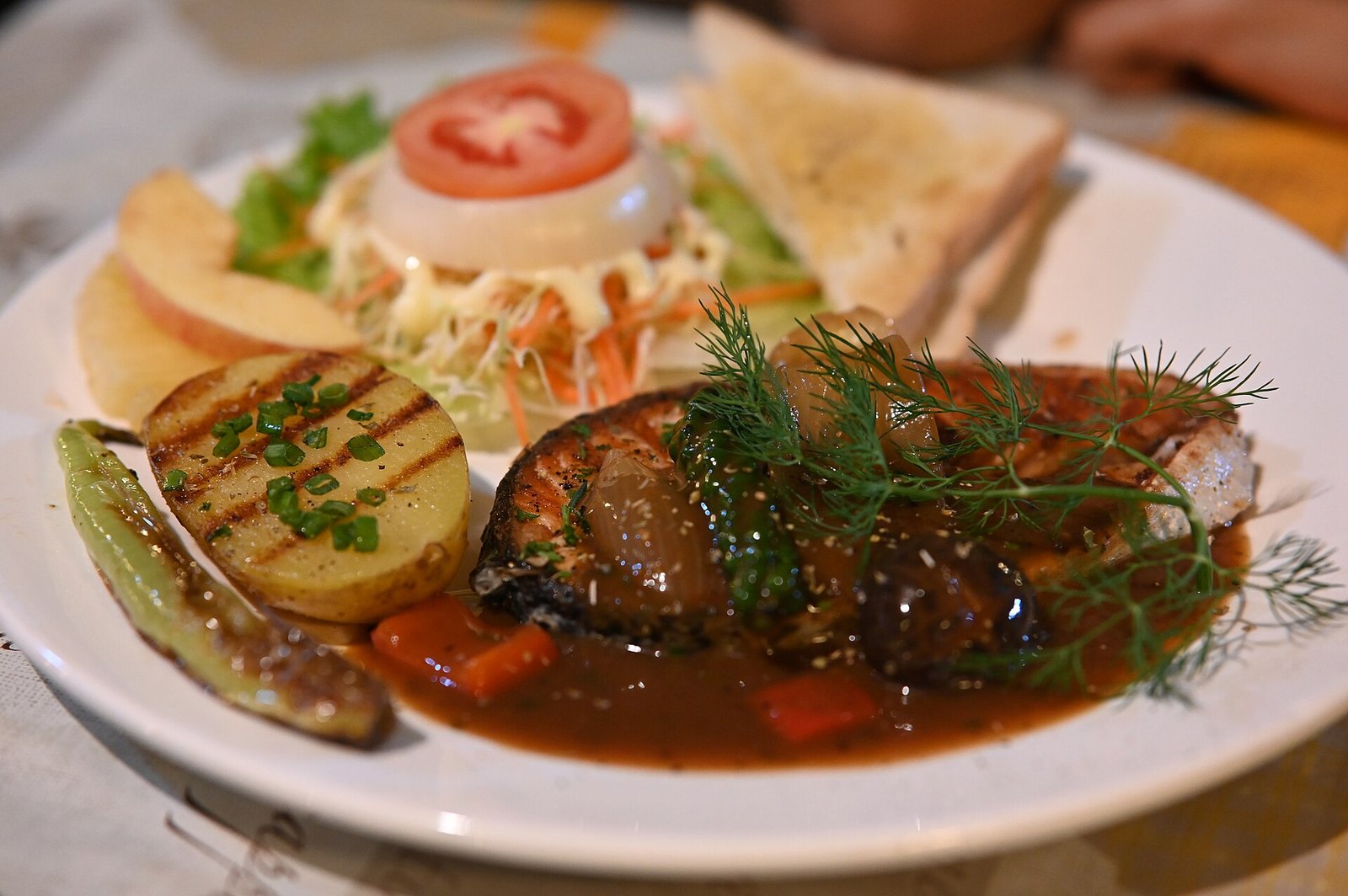
Image credits: Seared salmon by PattayaPatrol, CC BY-SA 4.0. Boiled eggs by LaviniaLaura, CC BY-SA 4.0. Both via Wikimedia Commons.