
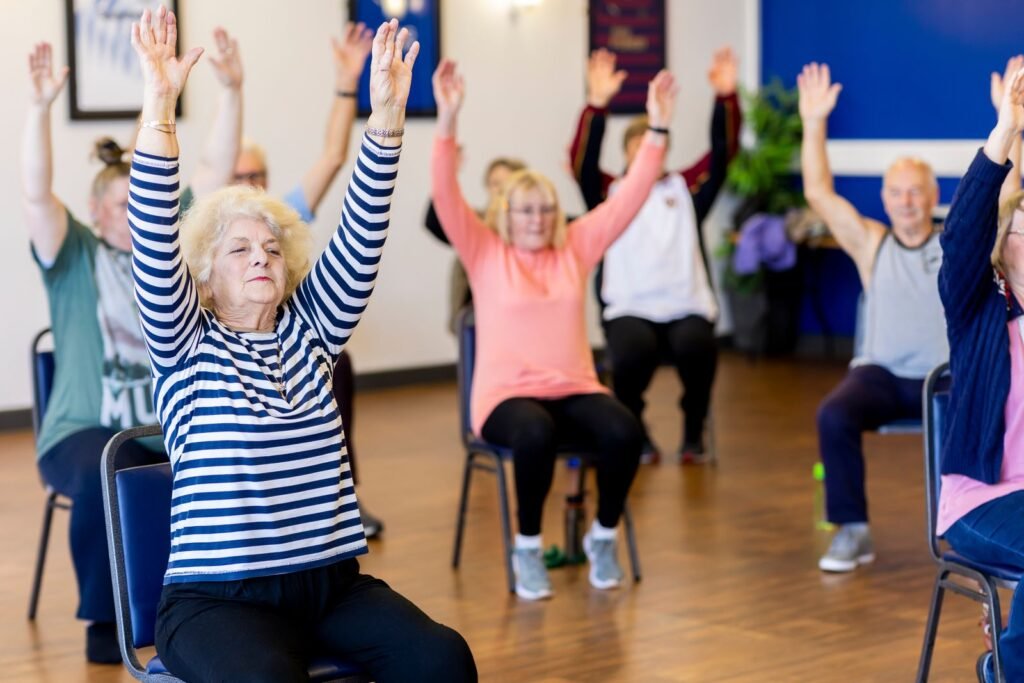
Here’s a number that should stop you for a second: one in two women over 50 will break a bone because of osteoporosis. Not one in fifty. One in two.
Most people don’t find out their bones are thinning until a fracture tells them. That’s the cruel part of osteoporosis — it’s called a silent disease for a reason, and by the time it shows up on an X-ray, you’ve usually already lost a meaningful amount of bone.
The good news is that bone, unlike a lot of what we associate with aging, responds to what you do with it. Not walking. Not stretching. Loading it, deliberately, the way you’d load a muscle you wanted to grow.
I’ve watched this play out in my own body. In my early 60s I went through a stretch of sarcopenia — real, measurable muscle and strength loss — after years of not training around old injuries. Coming back with the right kind of resistance work is what turned it around, and the same principle applies directly to bone.
If you’ve spent years avoiding weights because you thought they were risky, or because someone told you cardio was the safer bet for someone your age, this is the article that pushes back on that. The research points the other way.
Why Bone Loss Sneaks Up on You
Bone is living tissue. It’s constantly being broken down and rebuilt in a process called remodeling, and for most of your adult life, that process stays roughly in balance.
For women, that balance shifts hard around menopause. Estrogen plays a major role in slowing bone breakdown, and when estrogen drops, the rate of bone loss can accelerate to as much as 2 percent a year in the years immediately following menopause.
Men lose bone too, just more gradually, which is part of why the disease gets framed as a “women’s issue” when it isn’t purely one.
None of this shows up as pain. There’s no early warning ache that tells you your hip is getting more fragile. The first sign, for a lot of people, is a fracture from a fall that wouldn’t have broken anything twenty years earlier.
That’s what makes this different from most of the fitness advice you’ve probably heard. You can’t feel bone density improving the way you can feel a muscle getting stronger. You have to trust the process and the research, because your body won’t hand you feedback along the way.
It’s also why waiting until a bone scan flags a problem is the wrong strategy. Bone density peaks around age 30 and declines gradually after that for everyone, accelerating after menopause for women. The earlier you start loading your skeleton, the more you have banked before the decline speeds up.
Photo by Centre for Ageing Better on Pexels
The Exercise That Actually Builds Bone, Not Just Maintains It
For years, the standard advice for bone health was gentle: walking, light weights, avoid anything jarring. Some of that advice needs updating.
The LIFTMOR trial, published in the Journal of Bone and Mineral Research in 2018, put postmenopausal women with low bone mass through eight months of twice-weekly, high-intensity resistance and impact training — heavy lifts at roughly 85 percent of their max effort, plus controlled impact work like jumping. A comparison group did a low-intensity home program instead.
The high-intensity group significantly improved bone mineral density in the two places that matter most for fracture risk: the lumbar spine and the femoral neck, the part of the hip that breaks in a serious fall. The low-intensity group did not see the same gains.
This matters because it contradicts the instinct a lot of people have after 50, which is to get gentler with age. For bone specifically, gentle isn’t what stimulates new growth. Bone responds to load it’s not used to — that’s the actual trigger for your body to lay down more of it.
To be clear, this doesn’t mean untrained beginners should walk into a gym and start maxing out. The women in that trial were supervised, and the loading was progressive. But it does mean the ceiling on what’s safe and effective after 50 is a lot higher than most people assume.
What makes the LIFTMOR results especially notable is what didn’t happen. Researchers tracked adverse events closely throughout the trial, and the high-intensity program did not produce the injuries that skeptics assumed heavy lifting would cause in a population already dealing with fragile bones. Properly loaded resistance training turned out to be protective, not risky.
That finding alone should change how you think about the weight rack. The exercise most people over 50 are told to avoid is often the exercise that would help them most.
Photo by Leish on Pexels
What This Looks Like in Practice
The Bone Health and Osteoporosis Foundation’s guidance splits the work into two categories, and you need both.
Weight-bearing exercise means anything that has you moving against gravity on your feet: walking, dancing, stair climbing, using an elliptical. The Foundation recommends working up toward 30 minutes on most days.
Muscle-strengthening exercise means resistance work — bands, dumbbells, machines, or bodyweight — done two to three days a week. This is the piece most people over 50 are missing entirely, and it’s the piece the research keeps pointing to as the one that actually changes bone density, not just cardiovascular fitness.
You don’t need to replicate a lab protocol to benefit. What matters is progressive overload: doing a little more than your body is used to, on a schedule, over months. That might mean adding a rep, adding a small amount of weight, or simply improving your range of motion in a squat you’ve been doing with bent knees for years.
- Squats and sit-to-stands, loaded as you progress (chair, bodyweight, then weight)
- Rows and presses using resistance bands or dumbbells
- Step-ups, which combine loading with the impact bone responds to
- Deadlift-pattern lifts, taught with proper form, for the hip and spine specifically
- Controlled jumping or heel drops, once cleared and progressed appropriately
- Farmer’s carries, holding weight in each hand while walking, for grip and full-body loading
Getting Started Safely If You’re Already at Risk
If you’ve already been diagnosed with osteopenia or osteoporosis, or you’ve had a prior fracture, don’t take this article as a green light to start heavy lifting alone tomorrow. Talk to your doctor first, and ideally work with a trainer or physical therapist who understands progressive loading for bone health specifically.
The Bone Health and Osteoporosis Foundation is direct about this: if you’ve broken a bone due to osteoporosis or you’re at high fracture risk, some high-impact movements may need to be modified or avoided until you’ve built a base of strength and your provider has weighed in.
A qualified trainer will also teach you the difference between spinal flexion under heavy load, which is genuinely risky for a fragile spine, and a properly braced hinge or squat, which isn’t. That distinction is exactly why guidance matters early on, even if you end up training mostly on your own later.
For everyone else, the path is simpler than it sounds: start with bodyweight and controlled movement, add resistance gradually, and stay consistent. Bone remodels slowly. You won’t see a change in a month, but the research is clear that a properly loaded body over 40 is not on the same trajectory as one that stays sedentary.
A DEXA scan, the standard bone density test, is worth asking your doctor about if you’re over 50 and haven’t had one. It gives you a real baseline instead of a guess, and it turns this whole conversation from abstract into personal. You can’t manage what you haven’t measured.
None of this requires you to become someone you’re not. It requires two or three sessions a week, a plan that gets a little harder over time, and the patience to trust a process you can’t feel working in real time. That’s the whole strategy, and it’s the same one that’s protected strength and bone in every population it’s been studied in.
There’s also a mindset shift worth making here. A lot of people over 50 treat strength training as optional, something for people who are already fit. Bone health research says the opposite: resistance training becomes more necessary, not less, the further you get from 50. It’s not a bonus activity. It’s maintenance for a skeleton you’re going to need to rely on for decades.
Falls are the other half of this equation. Strong bones matter less if you’re at high risk of falling in the first place, and the same resistance and balance work that builds bone density also improves the stability that keeps you off the ground to begin with. The two problems share one solution.
Your bones aren’t fragile because you’re getting older. They’re fragile because they stopped being asked to do anything hard.
Building real bone density takes progressive, structured resistance training, not a random set of exercises you found online. Vinny’s Build Strong After 50 program walks you through exactly how to load your body safely and progressively over 12 weeks, whatever your starting point. Start building strength that actually protects you.
Sources
Watson SL, Weeks BK, Weis LJ, Horan SA, Beck BR, et al. — “High-Intensity Resistance and Impact Training Improves Bone Mineral Density and Physical Function in Postmenopausal Women With Osteopenia and Osteoporosis: The LIFTMOR Randomized Controlled Trial” — Journal of Bone and Mineral Research, 2018 — https://onlinelibrary.wiley.com/doi/abs/10.1002/jbmr.3284
Bone Health & Osteoporosis Foundation — “Be Bone Strong: Weight-Bearing and Muscle-Strengthening Exercises” — bonehealthandosteoporosis.org, 2025 — https://www.bonehealthandosteoporosis.org/preventing-fractures/exercise-to-stay-healthy/weight-bearing/
National Institutes of Health / NCBI — “The Frequency of Bone Disease — Bone Health and Osteoporosis” — NCBI Bookshelf, NIH, 2024 — https://www.ncbi.nlm.nih.gov/books/NBK45515/