
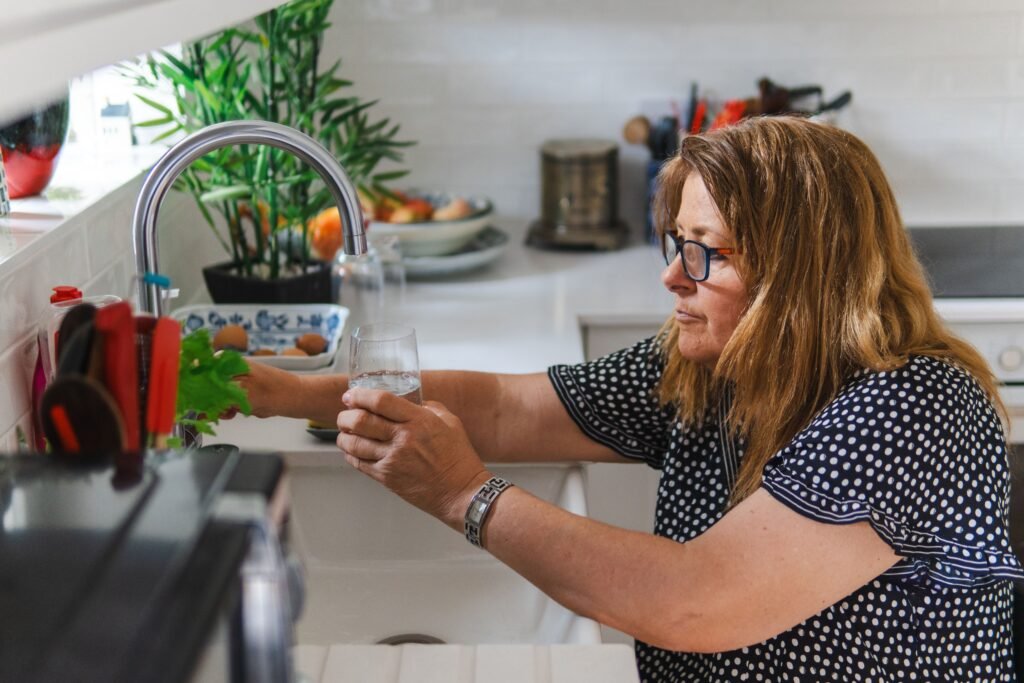
You probably don’t think about water much. You drink when you’re thirsty, you have your morning coffee, maybe a glass of wine with dinner, and you figure that covers it.
Here’s the problem: once you’re over 50, thirst stops being a reliable warning system. Your body can be running low on fluid for hours — sometimes days — before you actually feel it. And the fallout from that gap isn’t minor. It shows up in your energy, your joints, your blood pressure, your kidneys, even how sharp you feel by mid-afternoon.
I didn’t take hydration seriously for most of my life either. Forty years ago, I was too busy worrying about protein grams and training splits to think about a glass of water. It wasn’t until I hit my sixties, went through a real dip in strength and energy, and started paying closer attention to how my body actually felt — not just how hard I could push it — that I realized how much low-grade dehydration had been working against me the whole time.
This is one of those things nobody warns you about with aging, because it isn’t dramatic. Nobody ends up in the emergency room over it in most cases. It’s quiet. It just chips away at how you feel, day after day, until “tired” and “foggy” start to feel like your new normal. That’s exactly why it’s dangerous — and exactly why it’s worth fixing.
Why Your Thirst Signal Stops Working After 50
Your body’s thirst mechanism is supposed to work like a built-in alarm. Something in your brain notices your blood is getting more concentrated, and it tells you to drink before things get bad.
After 50, that alarm gets duller. Age-related changes in the way your body senses and responds to fluid loss mean you can be measurably dehydrated well before you ever feel the urge to reach for a glass of water. Researchers who study hydration in older adults have documented this blunted thirst response repeatedly — it isn’t a personal failing or a sign you’re not paying attention. It’s physiology, and it happens to nearly everyone to some degree.
Your kidneys are working against you here too. As you age, they gradually lose some of their ability to concentrate urine and conserve water, according to a peer-reviewed review on hydration status in older adults. That means you lose more fluid through ordinary daily function at 60 than you did at 30, even if your habits, your diet, and your activity level haven’t changed at all.
Put a duller thirst signal together with less efficient kidneys, and you’ve got a recipe for chronic, low-grade dehydration that most people never notice. It doesn’t announce itself with a dramatic symptom. It just quietly shows up as fatigue, dizziness, constipation, headaches, or that foggy, sluggish feeling by early afternoon that you’ve probably chalked up to “just getting older.” Often, it isn’t age doing that to you at all. It’s simply water.
What Chronic Low-Grade Dehydration Actually Costs You
This isn’t about waiting until you feel dizzy or your mouth goes dry. Real damage happens well before you’d ever notice something is wrong.
Researchers at the National Institutes of Health followed more than 15,000 adults for over 25 years, using blood sodium levels as a marker of hydration status — sodium rises in the blood as fluid intake drops. People whose blood sodium sat above 144 mmol/L, a sign of chronically lower fluid intake, had a 21% greater risk of dying at an earlier age than those in the middle of the normal range. They were also 50% more likely to show signs of accelerated biological aging, meaning their bodies were functioning older than their actual age on paper.
You don’t have to feel thirsty to be running dry — and by the time you do, you’re already behind.
Let that sink in for a second. These weren’t people who were severely dehydrated and hospitalized. These were ordinary adults going about ordinary life, just running a little dry, day after day, year after year. That steady low-grade deficit was enough to measurably speed up how fast their bodies aged, tracked over decades of real data, not a lab experiment.
Dehydration also raises your risk for kidney stones, urinary tract infections, and constipation — three things that tend to become more common, not less, as you get older. It thickens your blood slightly, which makes your heart work harder to circulate it every single day. And it reduces the fluid cushioning around your joints, which can make existing stiffness or arthritis feel noticeably worse than it needs to, especially first thing in the morning.
Even mild dehydration has been linked to worse concentration and short-term memory in the hours it’s happening. If you’ve ever felt unusually scattered or slow on a hot afternoon, that wasn’t just the heat. That was very likely fluid loss doing exactly what the research says it does.
The Kidneys, the Muscles, and the Meds Nobody Warns You About
Here’s where this gets personal for a lot of people reading this: medications.
Many common prescriptions for blood pressure and heart conditions — diuretics especially — increase fluid loss on top of everything your body is already losing naturally with age. If you’re on one of these and you’re also relying on thirst to tell you when to drink, you’re stacking two problems on top of each other without realizing it, and the gap between “fine” and “dehydrated” can close faster than you’d expect.
Muscle matters here too, more than most people think. Water isn’t just something you drink and forget about — a significant amount of it is stored directly in your muscle tissue. As you lose muscle mass with age, a process called sarcopenia, you also lose part of your body’s natural water reservoir. That’s one more reason strength training and hydration aren’t separate conversations. They’re connected, and neglecting one makes the other harder to manage well.
If you’re already dealing with joint pain, low energy, or that afternoon fog that makes you want to lie down at 2pm, hydration might not be the whole story. But I’d bet money it’s part of it. It was part of mine, and fixing it turned out to be one of the easiest, cheapest changes I ever made — cheaper than any supplement I ever bought, and it worked faster than most of them too.
A Simple System That Doesn’t Rely on Feeling Thirsty
Since you can’t trust thirst alone anymore, you need a system instead. This doesn’t have to be complicated, and it doesn’t require tracking every ounce that passes your lips.
- Start your day with a full glass of water before your coffee. You’ve gone six to eight hours without any fluid overnight, and coffee doesn’t rehydrate you the way plain water does.
- Keep a water bottle somewhere you’ll actually see it throughout the day — your kitchen counter, your desk, the console of your car. Out of sight really does mean out of mind here, especially once thirst stops doing its job.
- Check your urine color instead of waiting to feel thirsty. Pale yellow generally means you’re doing fine. Dark yellow is your cue to drink, regardless of whether you feel like you need to.
- Eat your water, too. Foods like cucumbers, watermelon, oranges, and soups contribute real fluid volume to your day, and they’re an easy way to close the gap without forcing down glass after glass.
- Set a simple checkpoint, like drinking a glass with every meal and every medication dose. Tying it to something you already do daily makes it far more likely to stick than a vague goal.
If you’re on a diuretic or have kidney or heart conditions that require a fluid restriction, talk to your doctor about your specific target. This is one area where “more is always better” isn’t universally true, and your doctor’s guidance should override any general advice, including mine.
None of this is complicated. It just has to be consistent. And consistency, more than intensity, is the whole game at this stage of your life — with hydration, and with pretty much everything else that actually moves the needle.
One more thing worth mentioning: heat and travel change the math. If you’re outside gardening, walking in the sun, flying somewhere dry, or just going through a stretch of hot summer days, your fluid needs go up whether or not your thirst tells you so. Build in a little extra on those days automatically, rather than waiting to see how you feel by the afternoon. By the time you feel it, you’re already catching up instead of staying ahead.
This is also a good one to loop in whoever you live with, or whoever checks in on you regularly. A quick “did you get your water in today?” from a spouse or an adult child isn’t nagging — it’s exactly the kind of external check that compensates for a thirst signal that isn’t as reliable as it used to be. There’s no shame in needing a reminder. I still set one on my phone most days, and I’ve been doing this for decades.
Keep Going
You don’t need to overhaul your entire life to start fixing this. You need one habit, done daily, starting today.
If you’re ready to build real momentum — not just with hydration, but with strength, energy, and how your whole body feels day to day — grab my free 5-Day Fit & Strong Reset. It’s a beginner-friendly program that only requires a resistance band, built for exactly the person reading this: someone who hasn’t been active in a while and wants a real starting point instead of another impossible plan. Visit SilverFitPlus.com to get it.
Sources
Dmitrieva NI, Gagarin A, Liu D, Wu CO, Boehm M (NIH/NHLBI) — “Middle-age high normal serum sodium as a risk factor for accelerated biological aging, chronic diseases, and premature mortality” — EBioMedicine, 2023 — https://www.nih.gov/news-events/nih-research-matters/link-between-hydration-aging
“Hydration Status in Older Adults: Current Knowledge and Future Challenges” — peer-reviewed review, PMC/NCBI, 2023 — https://www.ncbi.nlm.nih.gov/pmc/articles/PMC10255140/
National Council on Aging — “How to Stay Hydrated: A Guide for Older Adults” — 2024 — https://www.ncoa.org/article/how-to-stay-hydrated-for-better-health/