

You’ve probably done it a hundred times without thinking about it. Bend down, grab your toes, hold for ten seconds, call it a warm-up. That’s what “stretching” meant to most of us growing up — something you did for thirty seconds before gym class and never thought about again.
Then somewhere along the way, the fitness world discovered “mobility training” and decided stretching was old news. Now every trainer on social media is telling you mobility is the answer and stretching is a waste of your time.
Here’s the truth: they’re not the same thing, and after 50, you need to understand the difference. Your joints don’t care about the latest terminology. They care about what actually moves them safely and keeps moving them, week after week.
I’ve spent 40 years in gyms, and I’ve lived both sides of this argument in my own body. Bilateral shoulder arthritis and torn rotator cuffs in my early forties took me out of training for years. When I came back, I had to relearn what my joints actually needed — and it wasn’t more stretching. It was mobility, done right, at pain-free angles, built on a foundation of range I’d lost and had to earn back slowly.
What’s the Actual Difference
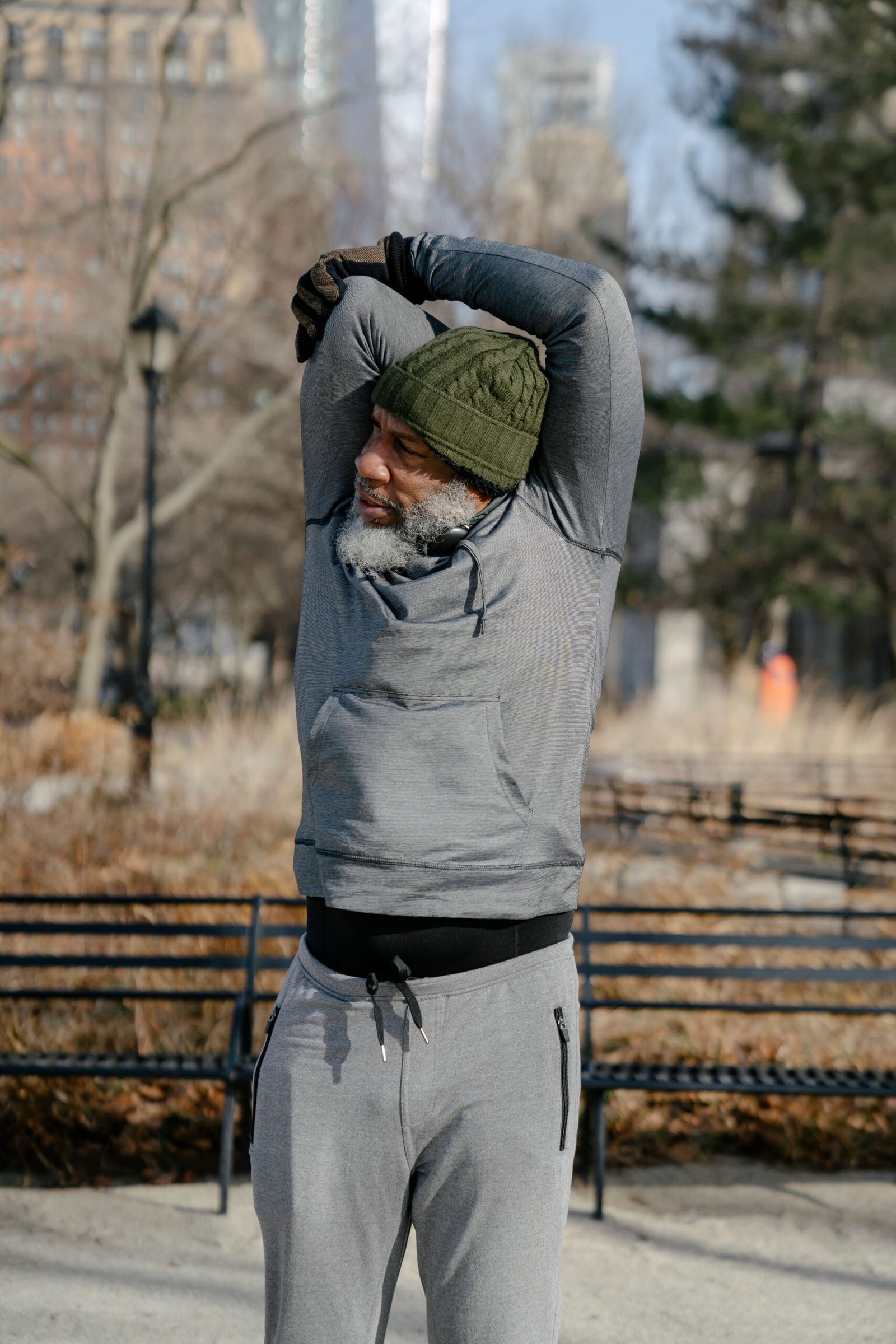
Stretching is about lengthening a muscle and holding it there. You reach for your toes, you feel the pull in your hamstrings, you hold for 20 to 30 seconds. It’s mostly passive. Your muscle lengthens under a steady, gentle load, but your joint isn’t necessarily doing much active work of its own.
Mobility training is different. It’s about how well a joint can move through its full range, under control, with strength behind it the entire way. Think of a slow, controlled shoulder circle against light resistance, or a deep, controlled squat where you’re actively holding and controlling every inch of the movement, not just sinking into it.
Both matter. Stretching builds the raw range of motion. Mobility work teaches your body to use that range with strength and control, which is what actually protects a joint during everyday life — reaching into the back seat of a car, getting up off the floor, carrying groceries up a flight of stairs.
If you’ve been sedentary for years, or you’re carrying arthritis or old injuries, the order and the emphasis you put on each one changes what your body gets out of it. Doing only one or the other leaves a gap.
“The only way to start when you’re not motivated is to do it anyway.”
What the Research Actually Shows

A 2023 study published in the Journal of Clinical Medicine compared proprioceptive neuromuscular facilitation (PNF) stretching against static stretching in older adults. Researchers found that both approaches improved knee joint range of motion and flexibility, both immediately and over the longer term, with PNF techniques producing some of the largest and most durable gains (Nuhmani, 2023).
That’s genuinely encouraging if you’re just getting started. Static stretching — the simple, hold-it-for-thirty-seconds kind — is not obsolete. It’s actually one of the more accessible, beginner-friendly ways to regain range of motion your joints have quietly lost from years of sitting at a desk or on a couch.
But range of motion by itself doesn’t protect you from falls. It doesn’t help you get out of a chair without pushing off with your hands. And it doesn’t build the strength your joints need to hold that new range under real-world load. That’s where mobility work earns its keep, and why it’s not something you can skip once you’ve stretched.
The National Institute on Aging’s Go4Life program specifically lists flexibility exercises as one of the four pillars of exercise for older adults, alongside strength, balance, and endurance. Notice that flexibility is one piece of the plan, not the entire plan on its own.
Mayo Clinic is equally clear about the practical payoff of stretching: regular stretching helps you maintain the range of motion you need for ordinary daily life — reaching overhead for a cabinet, stepping into a bathtub, turning to check your blind spot while driving. Those aren’t gym goals. Those are independence goals.
[CONTENT_IMAGE_1]
When Mobility Training Beats Stretching — And When It Doesn’t
If your knees feel stiff getting out of a chair or climbing stairs, mobility training — controlled, weight-bearing range of motion work — is going to do more for you long-term than sitting on the floor pulling on your hamstrings. Your knee needs to learn to move well while your body is actually using it under load, not just while you’re lying still.
If your shoulder has lost so much range that you can’t reach the top shelf, and it’s been that way for a long time, some patient static stretching to regain baseline range should come first. You can’t build strength or control through range you don’t have yet. Mobility work through a range your joint can’t reach just teaches your body to compensate somewhere else, usually your lower back or neck.
This is where I learned the hard way. After my rotator cuff injuries, I tried to force mobility work through angles that were already inflamed and unstable, because that’s what I’d always done. It set me back further, for months. What actually worked was finding pain-free angles first, using gentle, patient stretching to nudge the range back gradually, and only then layering in controlled, loaded mobility work once the joint could actually handle it.
A good working rule: if a joint is stiff but not painful, start with mobility training. If a joint has lost significant range and hurts when you try to load it, start with gentle stretching, then progress into mobility work as your range and comfort improve. Let the joint tell you which one it needs first — don’t decide in advance based on what worked for someone else, or what worked for you thirty years ago.
[CONTENT_IMAGE_2]
Building a Routine You’ll Actually Stick To
You don’t need an hour a day for this. You need consistency more than volume, especially in the beginning, and especially if you’re coming back from years off.
Try this: two or three days a week, spend five to ten minutes on gentle static stretches for whatever joint bothers you most — hips, shoulders, knees, whatever is talking to you the loudest. On the days you’re doing strength work, spend five minutes before you start on mobility drills for the joints you’re about to train: arm circles, bodyweight squats through a comfortable range, gentle hip openers.
Keep everything pain-free, not effort-free. Mild discomfort from stretching new range is normal and expected. Sharp pain, pinching, or pain that lingers after you stop is your body telling you to back off the range or the load, not to grit your teeth and push through it the way you might have been taught decades ago.
Track how you feel doing real things, not how you perform in the routine itself. Getting out of a chair without using your hands. Reaching for something on a high shelf without wincing. Bending down to tie your shoes without holding your breath. Those real-world markers matter far more than how far you can bend on any given day.
Two mistakes I see constantly with people starting out. The first is bouncing into a stretch, trying to force extra range in one aggressive push. That’s how you irritate a joint that was already cranky, and it teaches your nervous system to resist the stretch instead of relaxing into it. Ease into range slowly, hold it steady, and let your body settle there.
The second mistake is skipping mobility work entirely because stretching feels calmer and more familiar. Stretching alone will not rebuild the strength that protects your joints when you’re carrying laundry up the stairs or catching yourself on uneven ground. You need both pieces, even if one of them feels less comfortable at first. A simple weekly split works well for most beginners: stretching on your rest days, mobility drills built into the start of your strength days, and at least one full day where you do neither and just let your joints recover.
You Don’t Have to Figure This Out Alone
Your joints changed. That’s not a character flaw, and it doesn’t mean you’re done feeling capable in your own body. It just means the approach that worked at 25 has to change too, and that’s a normal, manageable adjustment, not a defeat.
Start small. Start today, even if today isn’t a particularly motivated day — those days are rare for most of us anyway. Your knees, hips, and shoulders will tell you exactly what they need if you’re willing to listen instead of pushing through everything the way you always have.
If you want a done-for-you starting point that respects exactly what we’ve covered here, my free 5-Day Fit & Strong Reset walks you through beginner-friendly movement — including joint-friendly mobility and stretching work — using nothing more than a resistance band. Visit SilverFitPlus.com to grab it and start rebuilding strength the way your joints actually respond to, not the way a 20-year-old’s would.
Sources
Nuhmani, S. — “Immediate and Long-Term Effectiveness of Proprioceptive Neuromuscular Facilitation and Static Stretching on Joint Range of Motion, Flexibility, and Electromyographic Activity of Knee Muscles in Older Adults” — Journal of Clinical Medicine, 2023 — https://pmc.ncbi.nlm.nih.gov/articles/PMC10095393/
National Institute on Aging — “Four Types of Exercise Can Improve Your Health and Physical Ability” — Go4Life — nia.gov
Mayo Clinic Staff — “Stretching: Focus on Flexibility” — Mayo Clinic, 2023 — mayoclinic.org