
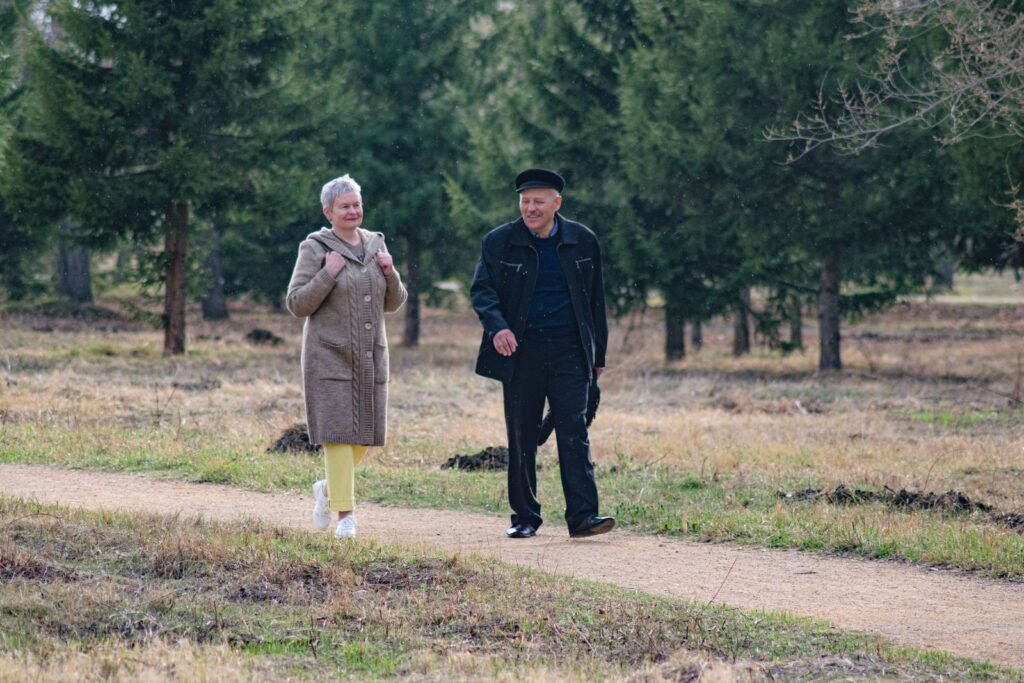
You’ve heard it from your doctor, your kids, maybe a well-meaning neighbor: “You need to get some cardio in.” You nodded, because they’re right. Then your knee reminded you what happened the last time you tried to jog around the block.
So you did nothing. That’s not laziness. That’s your body making a reasonable decision with bad information.
Here’s better information. Cardio after 50 doesn’t have to mean pounding pavement. There are at least four ways to get your heart working that go easy on cranky knees, hips, and backs. They’re not all equal, though. The right one for you depends on which joint is complaining and, just as important, which one you’ll actually keep doing.
I learned this the hard way. Bilateral shoulder arthritis and torn rotator cuffs shut me down in my early 40s, and I spent years avoiding anything that hurt. By my early 60s I was dealing with sarcopenia, real and measurable muscle loss. Coming back meant finding angles and machines that let me work without flaring things up. Cardio was a big part of that puzzle. Let me save you some of the trial and error.
Why “Low-Impact” Actually Matters for Your Joints
Every step you take sends force up through your ankles, knees, and hips. When researchers placed instrumented implants inside people’s knees and measured that load directly, the numbers were eye-opening.
In a 2010 study in the Journal of Biomechanics, Kutzner and colleagues found that ordinary level walking produced average peak knee forces of about 261% of body weight. Climbing stairs pushed that to roughly 316%. Going down stairs hit about 346%.
Read that again. Walking down a flight of stairs can put nearly three and a half times your body weight through your knee. If you weigh 180 pounds, that’s more than 600 pounds of force on every step down.
That doesn’t make walking bad. Far from it. It means that when a joint is already irritated, the amount of load matters. Low-impact cardio is simply cardio that dials the load down so you can train your heart and lungs without picking a fight with your cartilage.
And your heart does need the training. Skipping cardio because your knees hurt is how the downward spiral starts: less movement, weaker muscles around the joint, more pain, even less movement. The goal isn’t to avoid load forever. It’s to choose the right amount of it while you rebuild.
There’s another reason to keep moving. Joint cartilage doesn’t have its own blood supply. It depends on movement, the gentle squeeze and release of each step or pedal stroke, to circulate the joint fluid that keeps it nourished. A joint that sits still all day doesn’t get a rest. It gets starved. The right kind of cardio feeds it.
The Four Contenders, Ranked for Real Joints
Let’s go through the options one at a time. The good, the not-so-good, and who each one is best for.
The stationary bike. This is my top pick for most beginners with knee or hip arthritis. You’re seated, so the saddle carries your body weight instead of your joints. The motion is smooth and circular. There’s no landing, no jarring, and you control the resistance with a dial.
The research backs it up. A 2021 systematic review and meta-analysis in Clinical Rehabilitation by Luan and colleagues found that stationary cycling relieved pain and improved function in people with knee osteoarthritis. The authors were honest that it was less clearly helpful for stiffness and overall quality of life. That’s exactly why the bike works best as one tool in your kit, not the whole kit.
Best for knee and hip arthritis, anyone with balance worries, and people who like a precise, repeatable workout. A recumbent bike, the kind with a backrest, is even friendlier if your lower back complains.
The pool. Water holds you up. Stand in chest-deep water and buoyancy takes a large share of your body weight off your joints, while the water itself gives gentle resistance in every direction you move.
In a 2016 randomized trial in The Journal of Rheumatology, Alkatan and colleagues put 48 sedentary middle-aged and older adults with osteoarthritis on either a swimming or a cycling program for 12 weeks. Both groups saw significant drops in joint pain and stiffness. Both got stronger and walked farther on a six-minute walk test. And the improvements were about the same in each group.
That’s a powerful finding. Two very different low-impact options, and both worked. Best for people with several achy joints at once, people carrying extra weight, or anyone whose pain flares with any weight-bearing. You don’t even need to swim. Water walking and pool classes count.
The elliptical. The elliptical keeps your feet on the pedals the whole time, so there’s no pounding. You’re still standing, though, which means your joints carry more of your weight than on a bike. The upside is that standing work does more for your bones and your balance.
Best for people whose knees tolerate standing but hate impact, and for anyone ready to graduate from the bike. Start with low resistance and a short stride. Hold the stationary handles at first if balance is shaky.
Walking. Walking is free, it’s everywhere, and it builds the exact capacity you need for daily life. It’s also the highest-load option on this list, so it’s the one to build toward rather than force on day one if your knees are angry.
Best for people with mild or no joint pain, and as the long-term goal for everyone else. Flat, soft surfaces like a track or a smooth park path beat concrete and hills while you’re building up.
A word about rowers and arm bikes. Rowing machines are fantastic for a lot of people, but they ask a lot of your knees at the front of the stroke and your lower back throughout. If you have shoulder trouble like mine, the pulling can aggravate that too. Arm bikes, the upper-body cranks you see in rehab clinics, are a great option if your legs are the problem but your shoulders are healthy. Both have a place. Neither is where I’d send most beginners with sore knees on day one.
Pain is information, not a verdict. Pick the option your joints will tolerate today, and let it take you somewhere better tomorrow.
How to Choose, and How to Start Without a Flare-Up
Here’s the simple decision rule I give clients. Start with the option that lets you move for 10 minutes with pain no worse than a 3 out of 10, and no worse the next morning. That’s your starting point. Not your forever point.
Then use these guidelines for your first few weeks:
- Start short. Ten minutes, three days a week, is a real beginning. Add two or three minutes per session each week.
- Keep the effort conversational. You should be able to talk in full sentences. Breathing harder is fine; gasping is not.
- Warm up inside the workout. Spend the first three to five minutes at an easy pace before adding any resistance.
- Use the 24-hour test. If a joint feels worse the next morning than it did before you started, scale back the time or resistance next session. Don’t quit. Adjust.
- Rotate when you can. Bike on Monday, pool on Wednesday, a flat walk on Friday. Different machines load your joints differently, which spreads out the stress.
Here’s what a realistic first week might look like for someone with sore knees. Monday: 10 minutes on a recumbent bike at an easy pace. Wednesday: 15 minutes of water walking in the shallow end. Friday: 10 minutes on the bike again, maybe with one notch more resistance if Monday felt good. That’s 35 minutes for the whole week. It won’t look impressive on social media. It will get you to week two, and week two is where most people never arrive.
If you have a diagnosed heart condition, recent joint surgery, or pain that’s getting steadily worse, check with your doctor or a physical therapist before you start. Then start.
One more thing. Low-impact cardio is not a replacement for strength training. Your muscles are your joints’ shock absorbers. Stronger quads take pressure off your knees. Stronger glutes steady your hips. Cardio trains your heart. Strength training protects your frame. You want both.
The Real Reason Most People Quit (And How Not To)
Most people over 50 don’t quit cardio because of their joints. They quit because they picked something they hated, did too much in week one, and woke up sore and discouraged.
I know the feeling of not wanting to start. I’ve stood in my own garage looking at equipment and talked myself out of it more times than I’d like to admit. My motto came out of those moments: the only way to start when you’re not motivated is to do it anyway.
Not the perfect workout. Not the hour-long session. Just ten easy minutes on whichever option your body says yes to today.
Do that three times this week and you’ve already won something most people your age never get back: momentum. Motivation shows up after you move, not before.
Your joints aren’t asking you to stop moving. They’re asking you to move smarter. The bike, the pool, the elliptical, and the sidewalk are all doors back in. Pick the one that’s open to you right now and walk through it.
Ready to pair your cardio with the strength work that protects your joints? Grab my free 5-Day Fit & Strong Reset, a beginner-friendly PDF you can do at home with a single resistance band. It’s built for people starting from zero, sore knees and all. Visit SilverFitPlus.com to download it today.
Sources
- Kutzner I, Heinlein B, Graichen F, et al. — “Loading of the knee joint during activities of daily living measured in vivo in five subjects” — Journal of Biomechanics, 2010 — https://www.sciencedirect.com/science/article/abs/pii/S0021929010002095
- Alkatan M, Baker JR, Machin DR, et al. — “Improved Function and Reduced Pain after Swimming and Cycling Training in Patients with Osteoarthritis” — The Journal of Rheumatology, 2016 — https://www.jrheum.org/content/43/3/666
- Luan L, Bousie J, Pranata A, Adams R, Han J — “Stationary cycling exercise for knee osteoarthritis: A systematic review and meta-analysis” — Clinical Rehabilitation, 2021 — https://journals.sagepub.com/doi/10.1177/0269215520971795