

Let me guess what’s been stopping you. It’s not that you don’t know exercise is good for you. Everybody knows that. It’s that somewhere along the line, you picked up the idea that a “real” workout means an hour at the gym, sweat dripping, muscles shaking, and a recovery day spent walking like you fell off a horse.
If that’s the bar, of course you haven’t started. Nobody who’s been sitting for five, ten, or twenty years is going to leap from the recliner into a sixty-minute session. And when you can’t picture yourself doing the big thing, it’s easy to decide the small thing doesn’t count.
I want to take that idea apart today, because it’s wrong, and it’s costing you. Twenty minutes is enough to start. For a lot of people over 50, twenty minutes done consistently will do more for them than any hour-long plan they never follow.
I know this one personally. After my shoulders gave out in my early 40s, I stopped training for years. By my early 60s I was dealing with real muscle loss. When I came back, I didn’t come back with marathon sessions. I came back with short, pain-free work I could actually repeat. That’s what rebuilt me.
The “Hour at the Gym” Myth That Keeps You on the Couch
Here’s something most people never heard about. For years, the official U.S. physical activity guidelines said activity only counted toward your weekly total if it came in bouts of at least 10 minutes. In 2018, the Department of Health and Human Services dropped that rule in the second edition of the Physical Activity Guidelines for Americans.
Why? Because the research showed that any amount of movement provides health benefits. The old rule was actually discouraging people. Folks thought, “If I can’t do ten minutes, why bother?” The new message is simple: move more, sit less, and some activity is better than none.
Then in 2022, a study published in Nature Medicine took it further. Researchers led by Emmanuel Stamatakis looked at more than 25,000 adults in the UK Biobank who said they didn’t exercise at all. Their average age was about 62, which means this was your crowd, not a room full of athletes.
The participants wore activity trackers. The researchers found that people who got about three short bursts of vigorous everyday activity a day, each lasting only one to two minutes, had roughly a 38% to 40% lower risk of dying from any cause and nearly half the risk of dying from cardiovascular disease over the follow-up period. We’re talking about things like taking the stairs briskly, carrying heavy groceries, or walking fast to catch a bus.
That’s an observational study, so it can’t prove the bursts caused the benefit. But it lines up with everything else we know. Your body doesn’t check a stopwatch before it responds to effort. It responds to the effort itself.
Why 20 Minutes Is the Sweet Spot When You’re Starting From Zero
If a few minutes of effort can matter, why am I telling you twenty? Because twenty minutes is long enough to build real strength and short enough that you can’t talk yourself out of it.
Strength is the piece I care about most for this age group. After 50, we lose muscle every year we don’t use it, and that loss is what turns into weak legs, bad balance, trouble getting off the floor, and eventually a fall. Walking is wonderful, but muscle needs resistance.
Here’s the good news. A 2022 meta-analysis in the British Journal of Sports Medicine by Haruki Momma and colleagues pooled 16 studies and found that muscle-strengthening activities were linked to a 10% to 17% lower risk of death from all causes, heart disease, cancer, and diabetes. The biggest benefit showed up at just 30 to 60 minutes of strength work per week.
Read that again. Thirty to sixty minutes. Not per day. Per week. Two or three 20-minute sessions puts you right in that zone.
You don’t need more time. You need a smaller starting line, and the discipline to cross it again tomorrow.
There’s another reason twenty minutes works when you’ve been sedentary. Your joints, tendons, and ligaments adapt more slowly than your muscles do. Short sessions let your connective tissue catch up. You finish feeling like you could have done more, which is exactly how you want to feel at the start. That feeling brings you back. Being wrecked for three days does not.

Three 20-Minute Workouts You Can Do This Week
These are built for someone starting at true zero. No gym. No jumping. No floor work if getting down there is a problem. Move slowly, stay in a pain-free range, and stop any movement that causes sharp pain. If you have a heart condition, diabetes, or a recent surgery, check with your doctor before you begin.
Workout 1: The Chair Strength Circuit. Do each move for 40 seconds, rest 20 seconds, and repeat the full circuit three to four times.
- Sit-to-stand from a sturdy chair (use your hands on your thighs if you need them)
- Wall push-ups, hands at shoulder height, body in a straight line
- Seated knee lifts, alternating legs, sitting tall
- Standing calf raises with one hand on the chair back for balance
- Seated band rows, or a towel row if you don’t have a band yet
Workout 2: The Walk-and-Push Session. Walk for 5 minutes at an easy pace to warm up. Then walk for 12 minutes, alternating 2 minutes at a comfortable pace with 1 minute where you pick it up to “I could talk, but I wouldn’t want to sing.” Those faster minutes are your version of the bursts from the Stamatakis study. Finish with 3 minutes of slow walking.
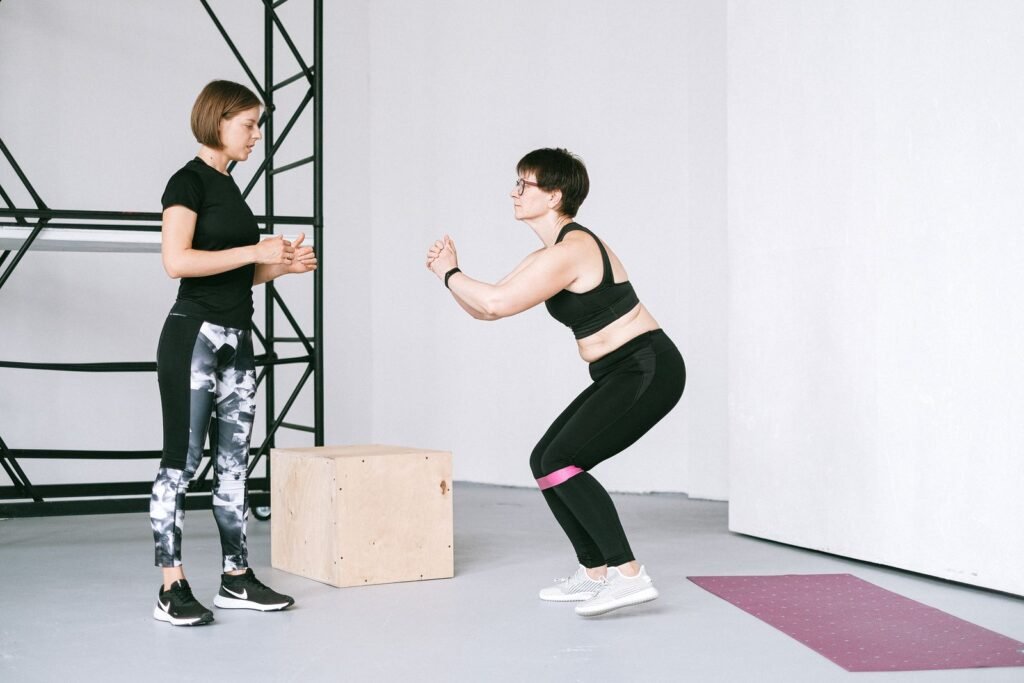
Workout 3: The Resistance Band Full-Body. Band work is joint-friendly because the tension builds gradually, which is why it was so central to my own comeback. Do 10 to 12 slow reps of each, rest a minute, and go through the list twice.
- Band rows, standing or seated, squeezing your shoulder blades together
- Band chest press, anchored behind you or wrapped around your back
- Band squats, standing on the band with handles at your shoulders
- Band pull-aparts at chest height, arms slightly bent
- Band hip abductions while holding a chair, band just above the knees
Before any of these, take two or three minutes to warm up. March in place, roll your shoulders, and circle your arms and ankles. Cold joints are cranky joints, and a short warm-up makes everything that follows feel smoother.
And if twenty minutes still feels like too much right now, that’s okay. Start with ten. Do one round of the chair circuit or half the walk. Add a few minutes each week. The goal is to finish every session wanting a little more, not dreading the next one. You’ll get to twenty sooner than you think.
Rotate these across the week. A simple rhythm: chair strength on Monday, walk-and-push on Wednesday, band full-body on Friday. That’s one hour of total training for the whole week, and it covers strength, heart health, and balance.
How to Make 20 Minutes Actually Happen
A short workout is only useful if you do it. And the hard part for most of the people I work with isn’t the exercise. It’s the first thirty seconds. Here’s what gets people through that doorway.
First, put it on the calendar like a doctor’s appointment. Same day, same time. “When I get around to it” never arrives. “Monday at 9:00 after coffee” does.
Second, set a timer and let the timer be the boss. When you know it ends in twenty minutes, the whole thing feels manageable. You’re not committing to a lifestyle overhaul. You’re committing to twenty minutes on a kitchen timer.
Third, lower the bar on bad days, but don’t skip. If you’re tired or sore, do one round instead of four. Put your shoes on and do five minutes. Most days you’ll keep going once you start. On the days you don’t, you still kept the habit alive, and the habit is what carries you.
Fourth, track it where you can see it. A check mark on a paper calendar on the fridge sounds almost silly. It isn’t. Watching a chain of check marks grow is one of the most motivating things you can do for yourself, and you won’t want to break it.
And finally, don’t wait to feel motivated. I’ve said it for years and I’ll keep saying it: the only way to start when you’re not motivated is to do it anyway. Motivation almost never shows up first. It shows up after you’ve done the work a few times and start to feel the difference.
Give yourself four weeks of twenty-minute sessions. Getting out of a chair will feel easier. The stairs will feel shorter. Your grocery bags will feel lighter. Those aren’t small wins. At our age, those are the wins that keep you independent.
You don’t have to become a gym person. You don’t have to love exercise. You just have to show up for twenty minutes, three times a week, and let your body do what it has always been built to do: get stronger when you ask it to.
Ready to take your first twenty minutes? Grab my free 5-Day Fit & Strong Reset, a beginner-friendly PDF that walks you through five short, joint-safe sessions using nothing but a resistance band. It’s built for people starting from zero, not people who already live at the gym. Visit SilverFitPlus.com to download it today and start this week.
Sources
- U.S. Department of Health and Human Services — “Physical Activity Guidelines for Americans, 2nd Edition” — Office of Disease Prevention and Health Promotion, 2018 — https://odphp.health.gov/sites/default/files/2019-09/Physical_Activity_Guidelines_2nd_edition_Presentation.pdf
- Stamatakis E, et al. — “Association of wearable device-measured vigorous intermittent lifestyle physical activity with mortality” — Nature Medicine, 2022 — https://www.ukbiobank.ac.uk/publications/association-of-wearable-device-measured-vigorous-intermittent-lifestyle-physical-activity-with-mortality/
- Momma H, et al. — “Muscle-strengthening activities are associated with lower risk and mortality in major non-communicable diseases: a systematic review and meta-analysis of cohort studies” — British Journal of Sports Medicine, 2022 — https://pubmed.ncbi.nlm.nih.gov/35228201/