
Here’s a moment you might recognize. You’re standing at the kitchen counter with a jar of pasta sauce, and the lid won’t budge. You run it under hot water. You tap it with a butter knife. Eventually you hand it to someone else, or you set it aside and tell yourself you’ll deal with it later.
It feels like a small thing. It isn’t. That jar is telling you something about your hands, and your hands are telling you something about the rest of your body.
I learned this the hard way. When arthritis and torn rotator cuffs took my shoulders out in my early 40s, I stopped training for years. What I didn’t notice at the time was how much I was losing everywhere else, including my grip. By my early 60s, sarcopenia had crept in, and simple things like carrying the groceries in one trip had turned into a negotiation.
If your knuckles ache in the morning, if your fingers feel stiff and clumsy, or if someone told you to “just rest them,” this article is for you. The research says something different, and it’s good news.
Why Your Grip Strength Matters More Than You Think
Grip strength sounds like a gym statistic. Researchers treat it as something much bigger: a quick window into your overall health.
In one of the largest studies ever done on the subject, Darryl Leong and colleagues followed nearly 140,000 adults across 17 countries as part of the PURE study, published in The Lancet in 2015. Every 5-kilogram drop in grip strength was linked to a 16% higher risk of death from any cause. Grip strength turned out to be a stronger predictor of death than systolic blood pressure.
That doesn’t mean squeezing a tennis ball will add years to your life. Grip is a marker. Strong hands usually belong to people who use their whole body: they carry things, lift things, and stay active. Weak hands often belong to people who have quietly stopped.
But here’s the part that matters to you: grip is trainable. At any age. Even with arthritis.
And your hands are involved in almost everything you do. Opening doors. Holding the railing on the stairs. Carrying a laundry basket. Lifting a grandchild. Pushing yourself up out of a low chair. When your grip goes, independence goes with it, one small task at a time.
What Arthritis Does to Your Hands (and Why Resting Them Backfires)
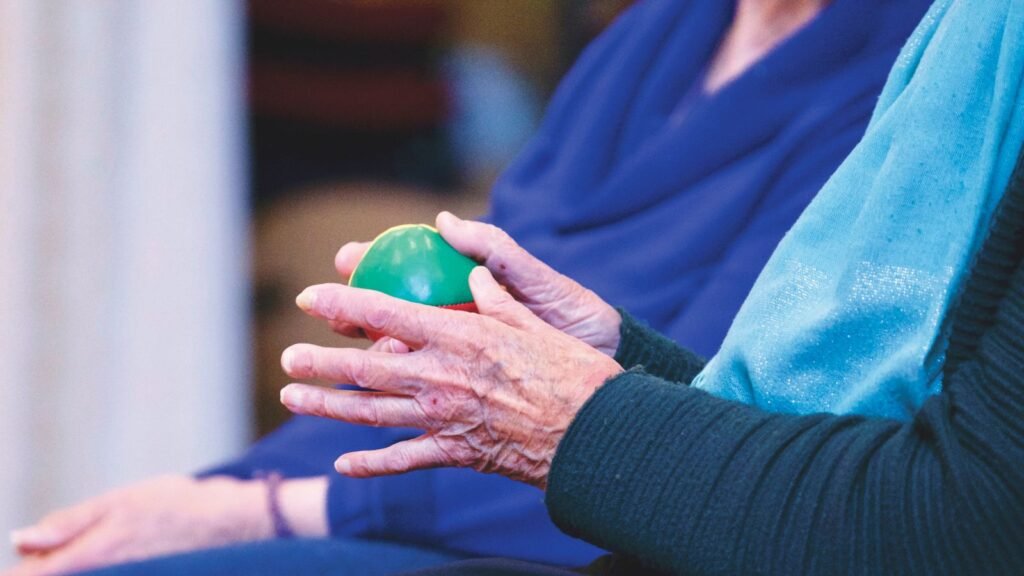
Hand osteoarthritis is common after 50, especially in women. It usually shows up in the joints closest to your fingertips, the middle knuckles, and the base of the thumb. You might notice bony bumps, stiffness first thing in the morning, or a deep ache after gardening, knitting, or typing.
The natural reaction is to protect your hands by using them less. You switch to the other hand. You avoid anything that hurts. Over months, that protection turns into weakness, and weakness leaves every joint working harder with less muscle around it for support.
It’s the same trap I fell into with my shoulders. Rest felt like the safe choice. It wasn’t. Joints that stop moving get stiffer, and muscles that stop working get smaller. Then the next task hurts more, so you do even less.
Researchers in Norway put hand exercise to the test. Toril Hennig and colleagues ran a randomized controlled trial with 80 women with hand osteoarthritis, average age about 61, published in the Annals of the Rheumatic Diseases in 2015. Half the women got information about their condition. The other half got the same information plus a simple home-based hand exercise program for three months.
The exercise group improved significantly in daily activity performance, grip strength, joint pain, and fatigue. The exercises were well tolerated. These weren’t athletes. They were ordinary women doing a few minutes of hand work at home.
A Cochrane review led by Nina Østerås in 2017 pooled the available trials and found small benefits for hand pain, function, and finger stiffness, with very few side effects, none of them serious. The effect isn’t magic. But it’s real, it’s free, and the risk is close to zero. That’s a trade worth taking.
Your hands don’t need to be protected from movement. They need to be protected by it.
The Ten-Minute Hand Routine You Can Do at the Kitchen Table
You don’t need fancy equipment. A soft foam ball, a rubber band, and a hand towel will cover it. Do this routine once a day, ideally after a warm shower or after soaking your hands in warm water for a few minutes. Warm tissue moves more easily.
Here’s the rule that matters most: work in a pain-free range. Mild stiffness or a feeling of effort is fine. Sharp pain, or pain that’s worse the next morning, means you went too far. Back off and use a smaller range next time. This is the same “pain-free angles” approach I used to rebuild my shoulders, and it works for fingers too.
- Gentle fist and open: Slowly curl your fingers into a loose fist with your thumb on the outside, then open your hand wide and spread your fingers. 10 slow reps per hand.
- Finger lifts: Rest your hand flat on the table. Lift and lower one finger at a time, then slide each finger toward your thumb. 5 rounds.
- Thumb touches and circles: Touch your thumb to the tip of each finger, making an “O” shape each time. Then make slow circles with your thumb. 5 rounds in each direction.
- Soft-ball squeeze: Squeeze a soft foam or therapy ball for 3 to 5 seconds, then relax completely. 10 reps per hand. If the base of your thumb aches, squeeze more with your fingers than your thumb.
- Rubber band spread: Loop a light rubber band around your fingers and thumb, then open your hand against it. This trains the muscles that open the hand, which almost everyone ignores. 10 reps per hand.
- Towel wring: Roll a small towel and gently wring it like you’re squeezing out water, one direction and then the other. 5 slow reps each way.
If your hands are sore, start with half the reps. Add a few each week. In the Hennig trial, the improvements showed up over three months of consistent practice, not three days. Patience is part of the program.
One more tip: tie the routine to something you already do every day. Right after your morning coffee works well. So does a commercial break during your favorite show. A habit with a hook is a habit that sticks.
How to Train the Rest of Your Body Without Wrecking Your Hands
Here’s where a lot of people with arthritic hands quit strength training altogether. Gripping a dumbbell hurts, so they decide lifting isn’t for them. That’s a mistake, because the rest of your muscles still need the work, and losing them is the road to sarcopenia. I’ve walked that road. I don’t recommend it.
Instead of quitting, change how you hold things:
- Go thicker: Thin handles force your fingers into a tight, painful curl. Foam handle covers, or a small towel wrapped around a dumbbell, spread the pressure out.
- Use a neutral grip: Palms facing each other is usually easier on the wrist and thumb than palms facing down.
- Let bands do the work: With a resistance band, you can loop the end around your wrist or forearm for many exercises, so your fingers barely have to squeeze.
- Use machines at the gym: Many machines load your arms or legs through pads, so you don’t need a tight grip at all.
- Adjust on flare days instead of stopping: Arthritis flares come and go. A flare day is a day for the gentle routine and leg work, not a reason to stop for a month.
And remember, your legs, hips, and back don’t care what your knuckles feel like today. Chair stands, step-ups, glute bridges, and wall push-ups with open palms keep your whole body strong while your hands catch up.
You’ll also find that as your legs and back get stronger, your hands get a break. Carrying groceries close to your body, using both hands instead of one, and standing up from a chair without pushing hard on the armrests all take pressure off your fingers. Strength anywhere makes life easier everywhere.
You don’t need perfect hands to get stronger. You need hands that are moving a little more each week, in a range that doesn’t hurt.
Maybe you’re not motivated. Maybe finger exercises at the kitchen table sound like the last thing you want to do tonight. I get it. I spent years not feeling like it. But the only way to start when you’re not motivated is to do it anyway. Ten minutes, today. Tomorrow that jar opens a little easier, and the day after that, a little easier still.
A quick safety note: if a joint is hot, red, or suddenly swollen, or if your pain keeps getting worse, check in with your doctor or a certified hand therapist. Inflammatory conditions like rheumatoid arthritis need medical care alongside exercise.
Ready to build strength for your whole body, gently? Grab my free 5-Day Fit & Strong Reset, a beginner-friendly PDF built for adults who are starting from zero. All you need is a resistance band, and many of the moves can be done with the band looped around your wrists instead of squeezed tightly in your hands. Visit SilverFitPlus.com to download it today.
Sources
- Leong DP, Teo KK, Rangarajan S, et al. — “Prognostic value of grip strength: findings from the Prospective Urban Rural Epidemiology (PURE) study” — The Lancet, 2015 — https://pubmed.ncbi.nlm.nih.gov/25982160/
- Hennig T, Hæhre L, Hornburg VT, Mowinckel P, Norli ES, Kjeken I. — “Effect of home-based hand exercises in women with hand osteoarthritis: a randomised controlled trial” — Annals of the Rheumatic Diseases, 2015 — https://ard.bmj.com/content/74/8/1501
- Østerås N, Kjeken I, Smedslund G, et al. — “Exercise for hand osteoarthritis” — Cochrane Database of Systematic Reviews (abridged in The Journal of Rheumatology), 2017 — https://www.cochrane.org/CD010388/exercises-for-hand-osteoarthritis