
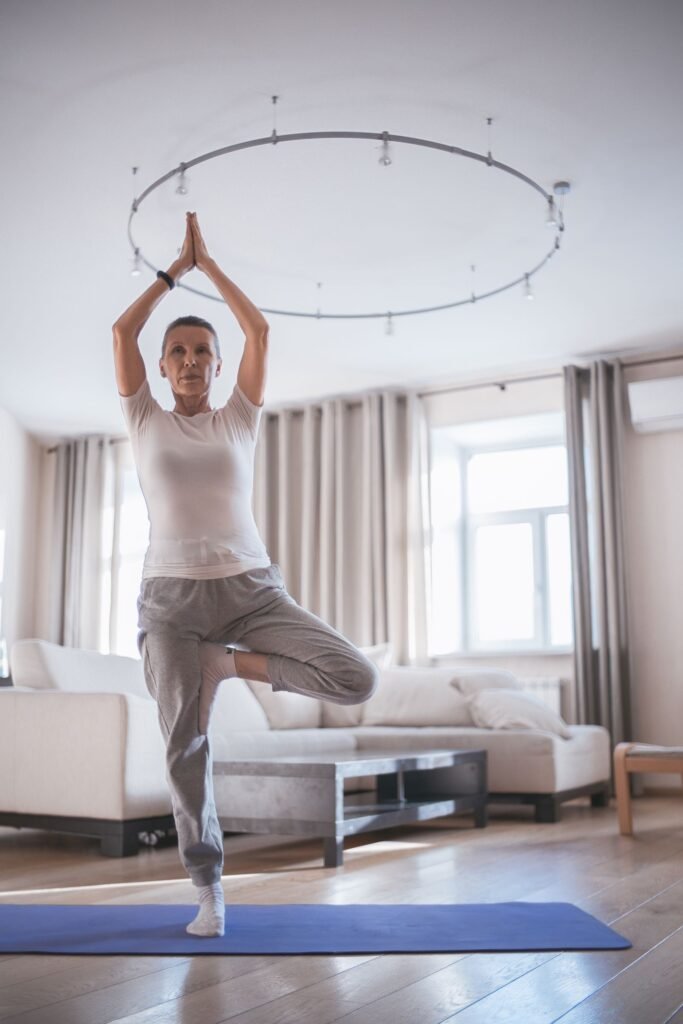
Try something for me right now. Stand up next to a kitchen counter or a sturdy chair, just in case. Kick off your shoes. Lift one foot and rest it lightly against the back of your other calf. Arms at your sides, eyes straight ahead. Now count to ten.
How did it go?
If you wobbled, grabbed the counter, or put your foot down at four or five seconds, you’re not alone. And you’re not doomed. But you did just learn something important, and I’d much rather you learn it from a kitchen counter than from a fall.
I’ve been training for over 40 years, and I’ll admit something. When I came back after years away from the gym, with sarcopenia setting in during my early 60s, my balance was one of the first things I noticed had slipped. Not my strength. My balance. It sneaks away quietly, because almost nobody tests it on purpose.
What the 10-Second Test Revealed
In 2022, a research team led by Claudio Gil Araújo published a study in the British Journal of Sports Medicine that got a lot of attention, and for good reason. They tested 1,702 adults between 51 and 75 years old on exactly the challenge you just tried: stand on one leg for 10 seconds, no support, up to three attempts.
About one in five couldn’t do it. Over a median of seven years of follow-up, 17.5% of the people who failed the test died, compared with 4.6% of those who passed. Even after accounting for age, sex, body weight, and conditions like diabetes and heart disease, failing the test was linked to an 84% higher risk of death from any cause.
Let’s be clear about what that means and what it doesn’t. Standing on one leg isn’t what keeps people alive. The test is a signal. Balance depends on leg strength, ankle mobility, reflexes, vision, your inner ear, and how well your brain and nerves talk to your muscles. When all of those systems are working together, you pass. When several are slipping, you don’t.
Think of it like a three-legged stool. One leg is what your eyes tell you. One leg is what your inner ear tells you. The third leg is what the nerves in your feet and ankles tell you about the ground underneath. Lose a little from one leg and the stool still stands. Lose a little from all three, and it tips over with the first nudge.
That’s why this test is so useful. It doesn’t need a lab, a machine, or a doctor’s appointment. It takes ten seconds and a kitchen counter, and it gives you an honest read on how well those three legs are holding up.
The researchers also saw that the ability to pass dropped off with each passing decade of age. That isn’t destiny. That’s what happens when balance doesn’t get trained, and most adults over 50 never train it at all.
Why Balance Fades and Falls Follow
Here’s the uncomfortable math. According to the CDC, about one in four adults age 65 and older reports falling each year. That’s more than 14 million people in the United States, and an estimated 9 million fall injuries serious enough to need medical care or limit activity for at least a day. Falls are also the leading cause of injury-related death in this age group.
Falls rarely come out of nowhere. They’re usually the end of a long, quiet slide. You sit more. Your legs get weaker. You stop walking on uneven ground because it feels unsteady. You grab the railing every single time. Each adjustment feels reasonable, but each one gives your balance system less practice.
And balance is a skill, the same way reading or driving is a skill. Skills you stop practicing fade.
There’s also the fear factor. Many people who’ve had a close call start moving less because they’re afraid of falling. That fear makes sense, but it backfires. Less movement means weaker legs and slower reactions, which raises the odds of the very fall they’re trying to avoid.
If any of that sounds like you, I want you to hear this: it isn’t a character flaw, and it isn’t too late. It’s a predictable result of a body that hasn’t been asked to balance in a while. Ask it again, and it starts answering.
Balance isn’t something you either have or you don’t. It’s something you practice, or something you lose.
The Good News: Balance Responds When You Train It
If balance were a fixed trait, that study would be depressing. It isn’t fixed.
A major Cochrane review led by Catherine Sherrington in 2019 pulled together the randomized trials on exercise for older adults living at home. In the main analysis, covering 59 studies and nearly 13,000 people, exercise reduced the rate of falls by 23%. Programs built around balance and functional exercises cut falls by about 24%. Programs that combined balance work with strength training did even better, at around 34%. Tai chi reduced falls by an estimated 19%.
That’s some of the strongest evidence in all of exercise science for older adults. And look at what the winning programs had in common: they challenged balance on purpose, and they built leg strength at the same time.
When I rebuilt my own balance, I didn’t do anything fancy. I stood on one leg while the coffee brewed. I walked heel-to-toe down the hallway with one hand near the wall. I did chair stands until my legs burned a little. It felt almost too simple to matter. Within a couple of months, the wobble I’d been ignoring was mostly gone, and I stopped reaching for the railing out of habit.
Balance also tends to improve faster than strength. Part of what you’re training is your nervous system, the wiring between your brain and your muscles, and that wiring wakes up quickly once you start asking it to work. Many people notice they feel steadier within just a few weeks of consistent practice.
You don’t need a gym, a wobble board, or a class to begin. You need a counter, a few minutes a day, and the willingness to wobble a little.
Your Week-One Balance Plan, Starting From Wherever You Are
Always practice next to a kitchen counter or a sturdy chair. Light fingertip support is fine. The goal is to challenge your balance safely, not to test your luck.
Pick the level that matches where you are today, and only move up when the current level feels easy:
- Level 1, feet together: Stand with your feet touching for 30 seconds. Too easy? Move on.
- Level 2, staggered stance: Put one foot half a step in front of the other. Hold 30 seconds, then switch.
- Level 3, heel-to-toe: Line one foot directly in front of the other, like you’re standing on a tightrope. Hold 30 seconds on each side.
- Level 4, one-leg stand: Lift one foot slightly off the floor. Work toward 10 seconds, then 20, then 30. Switch legs.
- Level 5, add a challenge: Slowly turn your head side to side, stand on a folded towel, or close your eyes for a second or two, only with the counter right in front of you.
Do 2 or 3 rounds of your level on most days of the week. It takes about five minutes. Brushing your teeth on one leg, with the sink right there, is an easy way to sneak it in.
What if Level 1 feels hard? Then Level 1 is your workout, and that’s perfectly fine. Hold the counter with both hands at first, then one hand, then a single fingertip. Every one of those steps is real progress. Nobody starts at the finish line, and nobody is grading you.
Then add strength, because strong legs catch you when balance alone can’t:
- Sit-to-stands from a sturdy chair: 2 sets of 8 to 10.
- Heel raises while holding the counter: 2 sets of 10 to 15.
- Side leg raises while holding the counter: 2 sets of 10 on each side.
- A daily walk that gradually includes a few minutes on grass, a gravel path, or a gentle slope.
Re-test yourself with the 10-second stand every two weeks, on both legs. Write the numbers down. Watching them climb is one of the most motivating things you’ll ever track, because it’s proof your body is still listening.
If you failed the test today, don’t let it scare you into the recliner. Let it get you out of it.
Not motivated? That’s fine. Motivation usually shows up after you start, not before. The only way to start when you’re not motivated is to do it anyway. Stand at the counter tonight. Lift one foot. Count. Tomorrow, do it again.
A quick safety note: if you’ve fallen recently, feel dizzy when you stand up, or have numbness in your feet, talk with your doctor before you start. A physical therapist can build a balance program around exactly what you need.
Want a simple place to start building the leg strength that keeps you steady on your feet? Download my free 5-Day Fit & Strong Reset. It’s a beginner-friendly PDF made for adults starting from scratch, and all you need is a resistance band. Visit SilverFitPlus.com and grab your copy today.
Sources
- Araújo CG, de Souza e Silva CG, Laukkanen JA, et al. — “Successful 10-second one-legged stance performance predicts survival in middle-aged and older individuals” — British Journal of Sports Medicine, 2022 — https://bjsm.bmj.com/content/56/17/975
- Sherrington C, Fairhall NJ, Wallbank GK, et al. — “Exercise for preventing falls in older people living in the community” — Cochrane Database of Systematic Reviews, 2019 — https://www.cochrane.org/news/new-cochrane-review-assesses-benefits-and-harms-exercise-preventing-falls-older-people-living
- Centers for Disease Control and Prevention (CDC) — “Older Adult Falls Data” — CDC Injury Center, 2024 — https://www.cdc.gov/falls/data-research/index.html