
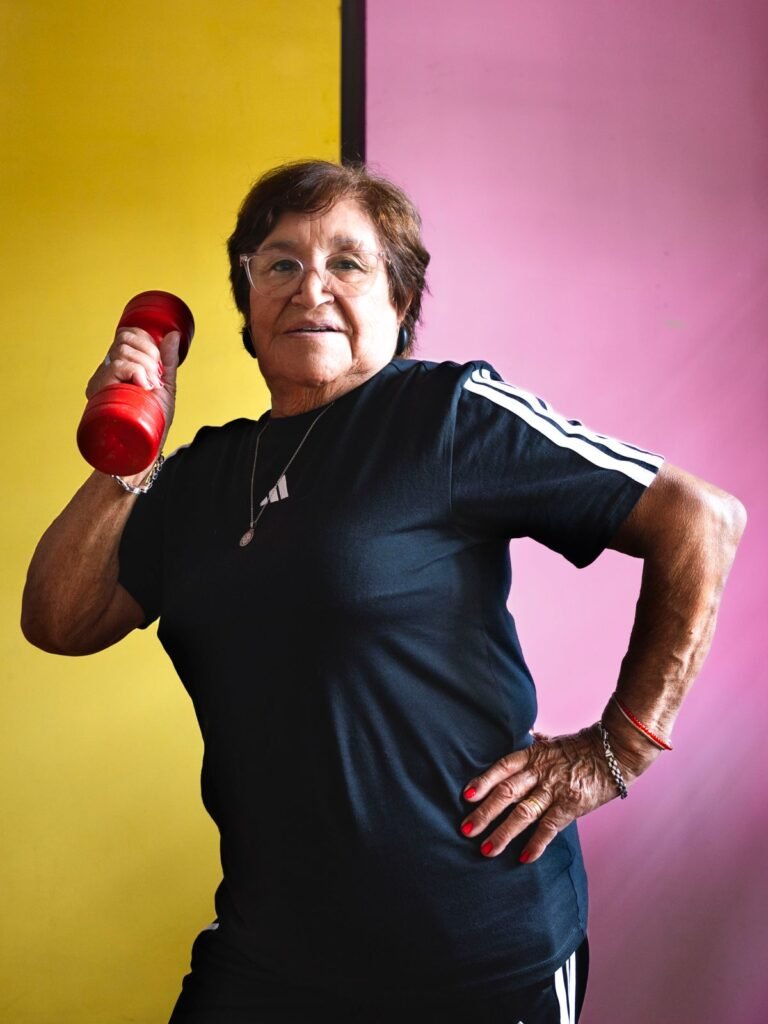
Let’s talk about the part of getting started nobody mentions. It isn’t the workout. It’s the picture in your head of the workout: getting down on a mat, getting back up, a room full of people who look nothing like you, and a body that hasn’t done anything strenuous in years.
If that picture has been enough to keep you on the couch, you’re not lazy and you’re not weak-willed. You’re being realistic about a plan that was never built for you. So let’s throw that plan out and start with something you already own: a sturdy kitchen chair.
The Chair Is Not a Cop-Out
I’ve been in gyms since I was 14. I trained under old-school bodybuilders who believed that if you weren’t suffering, you weren’t working. Then my shoulders gave out. Bilateral arthritis, torn rotator cuffs, and I walked away from training for years. When sarcopenia showed up in my early 60s, I had to learn something those old-timers never taught me: control the angle, and you control the pain.
A chair does exactly that. It supports your back, steadies your balance, and takes the fear of falling out of the equation. That means all your attention goes where it belongs, on the muscle doing the work.
And no, it isn’t a watered-down version of real exercise. A 2021 systematic review and meta-analysis led by Natalie Klempel, published in the International Journal of Environmental Research and Public Health, pulled together 25 studies of chair-based exercise in older adults. In the studies that could be pooled, people got measurably stronger. Handgrip strength improved, and so did performance on the 30-second chair stand and the 30-second arm curl.
The same review was honest about the limits, and so will I. Balance and walking-speed measures didn’t change significantly. The chair builds strength, but it isn’t the whole job, which is exactly why it’s a starting point and not a finish line.

Six Moves, Ten Minutes, No Floor Required
Pick a chair that doesn’t slide or wobble. Push it against a wall if you need to. Wear shoes with grip. Then work through these slowly, resting as long as you need between moves.
- Sit-to-stand: Scoot to the front edge of the seat, feet hip-width apart. Lean slightly forward and stand up, then lower yourself back down for a slow count of three. Start with 5 and build toward 10. This is the single most useful move in the routine because you do it every day of your life.
- Seated march: Sit tall and lift one knee, then the other, like you’re marching in place. Do 20 total. It wakes up your hips and gets your blood moving without any impact on your joints.
- Seated leg extension: Straighten one leg out in front of you, squeeze your thigh for a second, and lower it slowly. Do 8 to 10 per leg. Your quads are the engine that gets you out of chairs and up stairs.
- Heel raises: Stay seated with feet flat, then lift your heels and lower them slowly. Do 12 to 15. Strong calves help with walking and with steady footing.
- Seated band row: Loop a light resistance band around your feet, hold an end in each hand, and pull your elbows back as if you’re squeezing a pencil between your shoulder blades. Do 8 to 12. Keep your elbows low and close to your sides if your shoulders complain.
- Countertop push-up: Stand an arm’s length from the kitchen counter, hands on the edge, and lower your chest toward it, then push away. Do 5 to 8. It’s a real push-up at an angle your joints can forgive.
That’s the whole routine. Run through it once at first. When it feels easy, go around twice. Rest a minute between rounds.
One rule above all the others: pain is information. Muscle effort feels like a burn or a heavy, tired feeling. Sharp, pinching, or joint pain means stop, change the angle, or skip that move. If you have heart trouble, uncontrolled blood pressure, or a recent injury, check with your doctor before you begin.
A few honest answers to the questions I hear most. What if you can’t stand up from the chair without pushing off with your hands? Then use your hands. Push lightly off your thighs or the armrests, and aim to use them a little less each week. What if your knees ache on the way up? Raise the seat with a firm cushion so you start higher, and work your way down to a normal height over time. What if you can only manage two reps? Then two reps is today’s workout, and it counts.
Notice that none of those answers involve quitting. The routine bends to fit you, not the other way around. That’s the entire point of starting from a chair.
You don’t have to feel ready. You just have to sit down, stand up, and do one rep.

Why Ten Minutes Beats a Perfect Plan
Here’s what I tell everyone who sits across from me and says they have no motivation: good. Neither did I. My motto has carried me through the worst stretches of my life, and it’s simple. The only way to start when you’re not motivated is to do it anyway.
Motivation isn’t the thing that starts a habit. It shows up afterward, once you’ve done the thing and noticed you feel a little better than you did before. Waiting for the feeling first is why so many starts fall apart in week one.
So make the first step so small it’s almost embarrassing. Put the chair where you’ll see it. Do the routine at the same time every day, right after your morning coffee or right before the evening news. Link it to something you already do, and it stops requiring a decision.
Does ten minutes really count? According to the CDC’s physical activity guidance for adults 65 and older, adults should aim for muscle-strengthening activity on at least two days a week, plus about 150 minutes of moderate activity. The same page makes a point that every beginner needs to hear: some physical activity is better than none at all. You’re not behind. You’re at the starting line, and that’s a perfectly good place to be.
The strength side of that equation matters more than most people realize. In March 2026, the American College of Sports Medicine published a new position stand on resistance training in Medicine & Science in Sports & Exercise. Led by Stuart Phillips, it reviews more than 137 studies and over 30,000 participants, and it looks at how resistance training affects muscle, strength, and everyday function like walking speed, balance, and climbing stairs. The takeaway for you is that the field’s leading organization treats strength training as central to how we function, not an optional extra for gym people.
There’s one more thing standing between you and the chair, and it’s the voice that says it won’t matter at your age. It matters at every age. Muscle responds to being asked to work whether you’re 45 or 75, and the earlier in the process you start asking, the more of your independence you keep. Stairs, groceries, getting up off the garden bench, picking up a grandchild: all of it runs on the same leg and arm strength you’ll be training in your kitchen.
Think about what you actually want from the next ten years. Almost nobody answers with a number on a scale. They say things like “I want to travel,” “I want to stay in my own home,” and “I don’t want to be a burden.” Those are strength goals, whether they sound like it or not. Ten minutes in a chair is a down payment on every one of them.
Track your progress in a way that doesn’t involve a scale. Write down how many sit-to-stands you can do in 30 seconds today, then check again in a month. Seeing that number climb does more for your motivation than any pep talk I could give you.
When the Chair Gets Easy, Don’t Stop. Graduate.
In a few weeks, you’ll notice something. The sit-to-stands feel lighter. Getting out of the car takes less effort. You might catch yourself standing up from the couch without that little grunt. That’s the work showing up in real life.
That’s your cue to progress, one small step at a time. Here are a few ways to do it.
- Add reps first. Go from 5 sit-to-stands to 8, then to 10, before you change anything else.
- Slow it down. Take five full seconds to lower yourself into the chair. It’s harder than it sounds, and it works.
- Use a thicker band or hold a light dumbbell, or even a filled water bottle, during the rows and leg extensions.
- Add balance work, since the research says the chair alone doesn’t change it. Stand behind the chair, hold the back lightly, and practice standing on one foot for a few seconds.
Give it two weeks before you judge it, and then give it two more. Your body has been waiting a long time for you to ask something of it, and it responds faster than you think. I’m living proof. Muscle loss in my early 60s didn’t get the last word, and it doesn’t have to get the last word with you either.
If you want a plan that takes the guesswork out of what comes next, I built one for exactly this moment. The free 5-Day Fit & Strong Reset is a beginner-friendly PDF that walks you through your first five days of strength work, using nothing but a resistance band. Visit SilverFitPlus.com to download it, and start this week.
Sources
Natalie Klempel, Nicole E. Blackburn, Ilona L. McMullan, Jason J. Wilson, Lee Smith, Conor Cunningham, Roger O’Sullivan, Paolo Caserotti, Mark A. Tully — “The Effect of Chair-Based Exercise on Physical Function in Older Adults: A Systematic Review and Meta-Analysis” — International Journal of Environmental Research and Public Health, 2021 — https://pmc.ncbi.nlm.nih.gov/articles/PMC7920319
Stuart M. Phillips and colleagues, American College of Sports Medicine — “Resistance Training Prescription for Muscle Function, Hypertrophy, and Physical Performance in Healthy Adults: An Overview of Reviews” — Medicine & Science in Sports & Exercise, 2026 — https://acsm.org/science-spotlight-acsm-releases-new-position-stand-on-resistance-training/
Centers for Disease Control and Prevention — “Older Adult Activity: An Overview” — CDC Physical Activity Basics, 2025 — https://www.cdc.gov/physical-activity-basics/guidelines/older-adults.html