
If you are worried about your memory, you have probably been told to do puzzles. Crosswords, sudoku, brain-training apps. Maybe you tried for a week and quit, because it felt like homework.
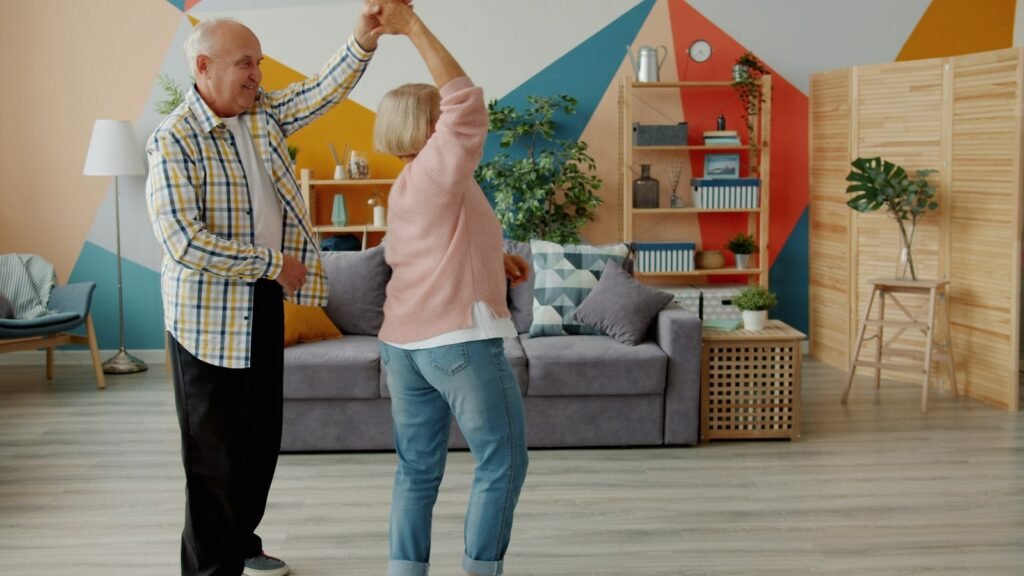
There is a different idea worth your attention, and it does not require a screen or a subscription. It is moving your body while your brain has to keep up. Learning a sequence of steps, remembering it, and doing it to a beat is a surprisingly demanding mental task.
I have been in the fitness world for more than 40 years, and I will tell you something that might surprise you: the people who stick with movement are rarely the ones grinding through reps. They are the ones who enjoy it. Let’s look at what the research says about dance, and then I will show you how to start in your own kitchen.
The only way to start when you’re not motivated is to do it anyway. Put on one song and take one step.
The Study That Put Dancing Up Against the Gym
Dr. Kathrin Rehfeld and her colleagues at the German Center for Neurodegenerative Diseases in Magdeburg ran a revealing experiment, published in Frontiers in Human Neuroscience in 2017. They followed healthy older adults, average age 68, for 18 months.
One group took a weekly dance class. They learned routines in jazz, square dance, Latin-American dance, and line dance. The steps, arm patterns, formations, and rhythms changed every couple of weeks, so the dancers were always learning something new.
The other group did a traditional fitness program: endurance and flexibility work, mostly repetitive exercises such as cycling or Nordic walking.
Both groups showed growth in the hippocampus, a part of the brain tied to memory, learning, and balance that tends to shrink with age. That is great news for anyone who is willing to exercise in any form.
But only the dancers showed a noticeable improvement in balance. The researchers pointed to the extra challenge of learning and recalling changing routines, often without instructor cues and under time pressure.
Here is what I take from this. Movement protects the brain, whatever form it takes. But when you add a thinking challenge on top of the movement, you may get an extra return. That is good news if you find walking boring.
Notice what the study did not require. Nobody had to train like an athlete. Nobody had to show up with a fitness history. These were healthy older adults who agreed to show up once a week for a year and a half. Consistency, not intensity, carried the day. That is the lesson I keep coming back to in my own training.
Why “Thinking While Moving” Matters
Let’s step back to a bigger picture. In 2003, Dr. Joe Verghese and colleagues at the Albert Einstein College of Medicine published a study in the New England Journal of Medicine that followed 469 community-dwelling adults over age 75 who did not have dementia at the start. Over a median of about five years, 124 of them developed dementia.
The researchers tracked leisure activities. Reading, playing board games, playing musical instruments, and dancing were each associated with a lower risk of dementia. Each additional point on their cognitive activity score was linked to a lower risk.
I want to be honest about the limits. This was an observational study. It cannot prove that dancing prevents dementia, and the authors themselves said that controlled trials are needed. People who dance may differ from people who do not in many ways. Interestingly, in that particular study, the overall physical activity score was not significantly linked to dementia risk.
So I will not tell you dancing is a cure. What I will say is this: the research so far points in a hopeful direction. Activities that combine movement, rhythm, memory, and often other people appear to be worth doing.
Think about what a simple grapevine step asks of you. You have to remember the pattern, coordinate your left and right sides, listen to the beat, and adjust your balance. That is several mental jobs happening at once. A crossword asks for one.
This also helps explain why many people feel better after a social dance class than after a solitary workout. You get movement, music, learning, and company in one hour. I am not claiming that bundle has been proven to prevent memory loss. I am saying that all four pieces are things your brain seems to like, and they are all things you can start without spending a dime.
If you play an instrument, read, or play board games with friends, you are already doing some of what the 2003 study measured. Keep going. You do not have to swap those out. Add to them.
You Don’t Need a Ballroom or a Partner
If the word “dancing” just made you want to close this tab, I get it. You may be sedentary, self-conscious, or carrying joints that complain. I have bilateral shoulder arthritis and rotator cuffs that tore in my early 40s, so I do not believe in forcing anything that hurts. Here is how to start at your own level.
- Start with one song. Pick a song you loved at 25. Stand beside a kitchen counter, hold on with one hand, and step side to side to the beat. Three minutes counts.
- Sit down if you need to. Seated dancing is real exercise. Tap your feet, swing your arms at a comfortable height, and shift your weight in the chair.
- Keep your arms below shoulder height. If your shoulders are cranky, you can do everything with your hands at your waist. Pain-free angles first, always.
- Learn one new step a week. Variety is the point. The dancers in the German study kept facing fresh routines, so keep it changing. Search for a beginner line dance or a slow salsa basic and learn it in pieces.
- Clear the floor and wear supportive shoes. Remove loose rugs, keep a sturdy chair or counter in reach, and skip the socks on slick floors.
Strength helps too. Dancing asks your legs, hips, and core to hold you steady, so a few minutes of band work or sit-to-stand practice will make every step feel easier. When I rebuilt my own body after years away from training, I found that stronger legs made every other activity safer and more fun.
If you get dizzy, short of breath, or feel chest pain, stop and talk to your doctor before continuing. If balance is a serious concern, start in a chair and ask your doctor or a physical therapist about the right level for you.
Making It Stick When You Don’t Feel Like It
Here is the truth about motivation: it almost never arrives first. It shows up after you start. That is why my motto is what it is. The only way to start when you are not motivated is to do it anyway.
Attach dancing to something you already do. Make a pot of coffee and dance one song while it brews. Put on music while you cook dinner. Do a song before you sit down for the evening. Small, repeatable, and tied to your day.
Then, when you are ready, find company. Many community centers, senior centers, and local studios offer beginner classes aimed at older adults, including chair-based classes. A class gives you a schedule, a teacher, and a reason to show up. It also gives you people, which matters because isolation is a problem of its own for memory and mood.
Expect to feel clumsy at first. That is not a sign you should quit. It is the exact feeling of your brain building something new. In the German study, the dancers were learning fresh material every couple of weeks, which means they were awkward again and again. And it still worked.
Track it simply. Put a mark on the calendar each day you dance, even for one song. In a month, you will have a row of marks, and that visible proof does more for your confidence than any speech from me.
And if you have a bad day, do the smallest version. One song. Even seated. The streak matters less than coming back, and coming back is a skill you build the same way you build everything else: by doing it anyway.
You are not too old, too stiff, or too far gone to learn something new. Your hippocampus responded to movement in adults averaging 68 years old, and 18 months of weekly effort made a measurable difference.
So skip the guilt about the crossword you did not finish. Put on a song you love, hold onto the counter, and learn the next step. Your memory is worth a few minutes of feeling silly.
Your memory deserves the same respect you give your car or your house. You maintain those. Give your brain something challenging, something joyful, and something with a beat.
Want a simple, joint-friendly way to build the strength and balance that make movement easier? Download my FREE 5-Day Fit & Strong Reset at SilverFitPlus.com. It is a beginner-friendly PDF, and all you need is a resistance band.
If you are ready to train in the gym, visit SilverFitPlus.com to see Build Strong After 50, my paid 12-week strength program designed around pain-free angles for adults over 50.
Free 5-Day Guide
Get the Free 5-Day Fit & Strong Reset
A joint-safe, beginner-friendly start for adults over 50. Enter your email and the guide goes straight to your inbox.
No spam. Unsubscribe anytime.
Sources
Rehfeld K, et al. — “Dancing or Fitness Sport? The Effects of Two Training Programs on Hippocampal Plasticity and Balance Abilities in Healthy Seniors” — Frontiers in Human Neuroscience, 2017 — Summary: https://www.frontiersin.org/news/2017/08/29/dancing-can-reverse-the-signs-of-aging-in-the-brain
Verghese J, Lipton RB, Katz MJ, et al. — “Leisure Activities and the Risk of Dementia in the Elderly” — New England Journal of Medicine, 2003;348(25):2508-2516 — https://pure.psu.edu/en/publications/leisure-activities-and-the-risk-of-dementia-in-the-elderly/