
You’ve seen it at the gym. Someone on the floor, rolling a piece of dense foam under their thigh, wincing like they’re paying off a debt. Maybe you bought one yourself a few years back, used it twice, and it’s been sitting in your closet ever since.
Here’s what nobody told you: foam rolling can genuinely help your joints feel better as you get older. But almost none of the advice out there is written for someone dealing with arthritis, an old rotator cuff tear, or a hip that just doesn’t move like it used to.
I’ve been rolling out my own shoulders and hips for years, ever since bilateral shoulder arthritis and torn rotator cuffs took me out of training in my early forties. I remember being afraid that any pressure near a joint would make things worse. It won’t — once you know what you’re actually doing.
Here’s why this matters more the older you get. As we age, the fluid that lubricates our joints thins out, cartilage loses some of its cushioning, and the muscles surrounding a joint tend to tighten up from years of sitting, guarding against old injuries, or simply not moving through a full range of motion anymore. That combination is what makes a fifty-five-year-old’s knee feel stiff climbing stairs when it never used to.
None of that means you’re broken. It means the tissue around your joints needs a little help doing what it used to do on its own. That’s exactly the gap foam rolling is built to fill.
What Foam Rolling Actually Does to Your Joints and Muscles
Foam rolling isn’t magic, and it isn’t fixing your joint directly. What it does is apply steady pressure to the muscle and connective tissue — the fascia — surrounding a joint, which loosens tension and improves blood flow to the area.
Think of your muscles like rope that’s gotten stiff and knotted from disuse. Foam rolling doesn’t repair the rope, but it works out the knots so the rope moves the way it’s supposed to again. That matters more than you’d think, because tight, stiff muscles around a joint are often what makes the joint itself feel worse.
A 2015 systematic review in the International Journal of Sports Physical Therapy looked at more than a dozen studies and found that self-myofascial release with a foam roller measurably improved joint range of motion without hurting strength or performance. That’s the opposite of what a lot of people assume — that rolling around on foam is just a warm gym trend with no real payoff.
More recent research backs this up specifically at the joint level. A 2024 study published in Scientific Reports found that self-myofascial release using foam rollers improved knee joint mobility and reduced pressure pain sensitivity in the muscles around the knee. The people in that study weren’t elite athletes. They were regular adults dealing with regular tightness — the kind you probably feel every morning getting out of bed.
There’s also a circulation piece to this that matters as we age. Rolling increases blood flow to the muscle tissue you’re working on, and better circulation means more oxygen and nutrients reaching tissue that’s had years of getting less attention than it needs. That’s part of why people report feeling looser and less achy after a session, even though nothing about the joint itself has structurally changed in those ten minutes.
It’s also worth saying plainly: foam rolling won’t hurt your performance the way some people fear xe2x80x9cstretching things out too muchxe2x80x9d might. The 2015 review found no evidence that rolling before activity weakens the muscle or makes you less stable. If anything, it tends to make the next thing you do — a walk, a strength session, a game of pickleball — feel more comfortable getting into.
You don’t need to hurt to heal. You need to show up consistently, gently, and long enough for your body to learn it can trust you again.
The Right Way to Foam Roll When You Have Arthritis or Old Injuries
This is the part almost every fitness article skips, and it’s the part that matters most for you.
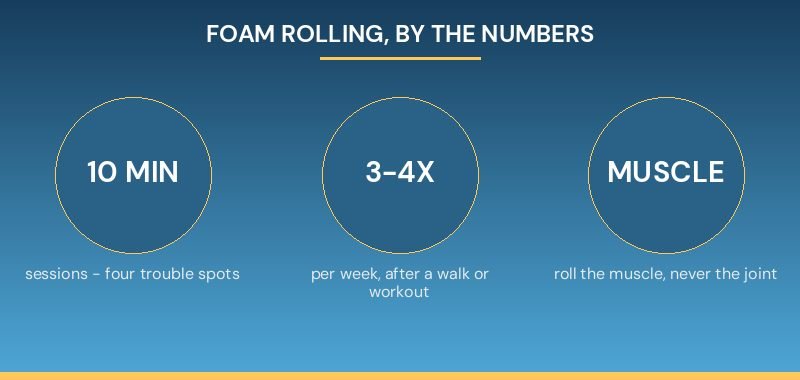
Rule one: roll the muscle, never the joint. If you’re working on your knee, you roll your quad and your calf — not the kneecap itself. If your shoulder is the trouble spot, you work the muscles of your upper back and the sides of your torso, not the joint capsule.
Rule two: start soft. A firm, dense foam roller might be fine for a 30-year-old athlete, but for aging joints and arthritic tissue, a softer roller is the smarter starting point. As guidance from MD Anderson Cancer Center’s wellness team notes, gentler pressure and shorter sessions are the safer approach as your muscles and joints age — you can always add pressure later, but you can’t undo an angry joint.
Rule three: five to ten minutes is plenty when you’re starting out. This isn’t a competition to see how much discomfort you can absorb. If a spot feels tender, ease off, breathe, and let the pressure sink in slowly instead of grinding on it.
Rule four: skip it during an active flare-up. If a joint is hot, swollen, or actively inflamed, foam rolling the surrounding muscle can wait until things calm down. This is where checking in with a physical therapist or your doctor is worth the phone call, especially if you’re not sure whether what you’re feeling is normal stiffness or something more serious.
A Simple Foam Rolling Routine for Your Most Common Trouble Spots
You don’t need a complicated plan. You need four spots and ten minutes.
Start with your calves. Sit on the floor, roller under one calf, and roll slowly from ankle to knee. This is a safe, low-risk area to build confidence with the tool.
Move to your quads. Lie face down with the roller under your thighs and roll from just above the knee to your hip. Go slow — twenty to thirty seconds on any spot that feels tight, breathing the whole time.
Work your upper back next. Lie on your back with the roller placed horizontally beneath your shoulder blades, knees bent, feet flat. Gently roll from mid-back up toward your shoulders. This is especially useful if you carry tension in your neck and shoulders, which most desk-bound, stressed-out adults do.
Finish with your hips and glutes. Sit on the roller, shift your weight to one side, and roll slowly through the glute muscle. This is one of the most common tight spots that quietly makes your lower back and hips feel worse than they need to.
Three to four times a week, ten minutes total, ideally after a walk or workout when your muscles are already warm. That’s the whole plan. No fancy equipment, no gym membership, no pain required.
A few small things make a big difference here. Breathe slowly and steadily the whole time — holding your breath while you roll just adds tension you’re trying to release. Keep a towel or yoga mat under you for comfort on hard floors. And track how you feel over two weeks, not one session. Foam rolling is cumulative. The first time might feel like nothing special. By week two, most people notice they’re moving into their day without that first-ten-minutes stiffness they used to write off as xe2x80x9cjust getting older.xe2x80x9d
When Foam Rolling Isn’t Enough (And What to Do Instead)
Foam rolling is a tool, not a treatment plan. It will not reverse arthritis. It will not rebuild a torn rotator cuff. It will not replace the muscle you’ve lost.
What it does is create a little more room to move — looser tissue, better circulation, less nagging tightness — so that the real work, which is strength training at pain-free angles, is more comfortable to do. That’s the order that actually works: loosen up, then build strength around the joint so it has support it didn’t have before.
If you notice sharp pain, sudden swelling, or numbness anywhere you’re rolling, that’s your body telling you to stop and get it checked out. Foam rolling should never feel like an emergency. It should feel like maintenance — the kind you do because you’re planning on using this body for a long time yet.
I stopped training for years after my shoulders gave out on me, and I came back slower and more stubborn than I went in. Foam rolling was one of the small, boring tools that helped me get moving again without setting myself back. It’s not glamorous. It works anyway.
Ready to put this into practice with a full plan, not just one tool? Grab Vinny’s free 5-Day Fit & Strong Reset — a beginner-friendly program that only requires a resistance band and meets your joints exactly where they are. Visit SilverFitPlus.com to download it and get started today.
Cheatham, S.W., Kolber, M.J., Cain, M., Lee, M. — xe2x80x9cThe Effects of Self-Myofascial Release Using a Foam Roll or Roller Massager on Joint Range of Motion, Muscle Recovery, and Performance: A Systematic Reviewxe2x80x9d — International Journal of Sports Physical Therapy, 2015 — https://pmc.ncbi.nlm.nih.gov/articles/PMC4637917/
Kim, et al. — xe2x80x9cRecovery effect of self-myofascial release treatment using different types of foam rollersxe2x80x9d — Scientific Reports, 2024 — https://www.nature.com/articles/s41598-024-66577-x
MD Anderson Cancer Center — xe2x80x9cThe Benefits of Foam Rollingxe2x80x9d — Cancerwise, MD Anderson — https://www.mdanderson.org/cancerwise/the-benefits-of-foam-rolling-.h00-159778023.html