

Maybe your doctor put you on one of the newer weekly shots for type 2 diabetes. Semaglutide (Ozempic), tirzepatide (Mounjaro), or something like them. Your blood sugar is finally coming down. The scale is moving for the first time in years.
That’s real progress, and I’m not here to talk you out of it. These medications have changed a lot of lives, and the decision to take one belongs to you and your doctor.
But there’s a part of the story nobody explained when you picked up that prescription. When you lose weight fast, you don’t only lose fat. You can lose muscle, too.
And after 50, muscle is the one thing you cannot afford to give away. Especially when you’re fighting diabetes.
Why Weight Loss Isn’t the Same as Fat Loss
The scale doesn’t tell you what you lost. It only tells you how much. Some of that weight is fat. Some of it is water. And some of it is lean mass, which includes your muscle.
A 2024 review in Diabetes, Obesity and Metabolism, led by Ian Neeland, looked at how body composition changes on GLP-1-based medications. The results varied widely from study to study.
In some studies, lean mass made up about 15% or less of the total weight lost. In others, it was 40% to 60%. The authors point out that lean mass also includes organs, bone, and fluid, so not all of it is muscle.
They also note that the amount you lose depends on your age, your health, and how much weight comes off. Older age is one of the factors that raises the risk. That means you, reading this, should be paying attention.
Here’s why it matters so much when you have diabetes. Your muscle is your body’s biggest blood sugar sponge. After a meal, your muscles pull glucose out of your bloodstream to burn it or store it for later.
Less muscle means less storage space for that sugar. So the muscle you keep isn’t just about strength or looks. It’s part of your diabetes treatment, working every single time you eat.
I know what losing muscle feels like. In my early 40s, arthritis in both shoulders and torn rotator cuffs forced me to stop training for years. By my early 60s, I was dealing with sarcopenia, real age-related muscle loss.
I wasn’t on any medication. I just stopped using my muscle, and it left. Stairs got harder. Jars got harder. I felt older than my age. Muscle doesn’t announce that it’s leaving. You notice it after it’s gone.
The good news is the same thing that brought me back can protect you: training at angles that don’t hurt, consistently, a little at a time.
What the Experts Now Recommend Alongside the Medication
The medical world has noticed this problem. In 2025, four major organizations released a joint advisory on nutrition and lifestyle for people taking GLP-1 medications: the American College of Lifestyle Medicine, the American Society for Nutrition, the Obesity Medicine Association, and The Obesity Society.
The advisory, led by Dariush Mozaffarian of Tufts University and published in The American Journal of Clinical Nutrition and three other journals, named muscle and bone loss as one of the challenges of these drugs. One of its stated priorities: adequate protein intake and strength training to preserve lean mass.
The American Diabetes Association’s 2025 Standards of Care point the same direction. For people working on weight loss, the guidelines recommend fitting in strength training two to three times a week to avoid muscle loss. They also call for screening people on weight-management treatments for malnutrition.
Put that together and the message is simple. The medication works best as one part of a plan, not the whole plan.
The shot can lower your appetite and your blood sugar. It cannot build muscle. Only you can do that.
“The medication can help you lose the weight. Only you can decide to keep the muscle.”

Your Muscle-Protection Plan, Starting This Week
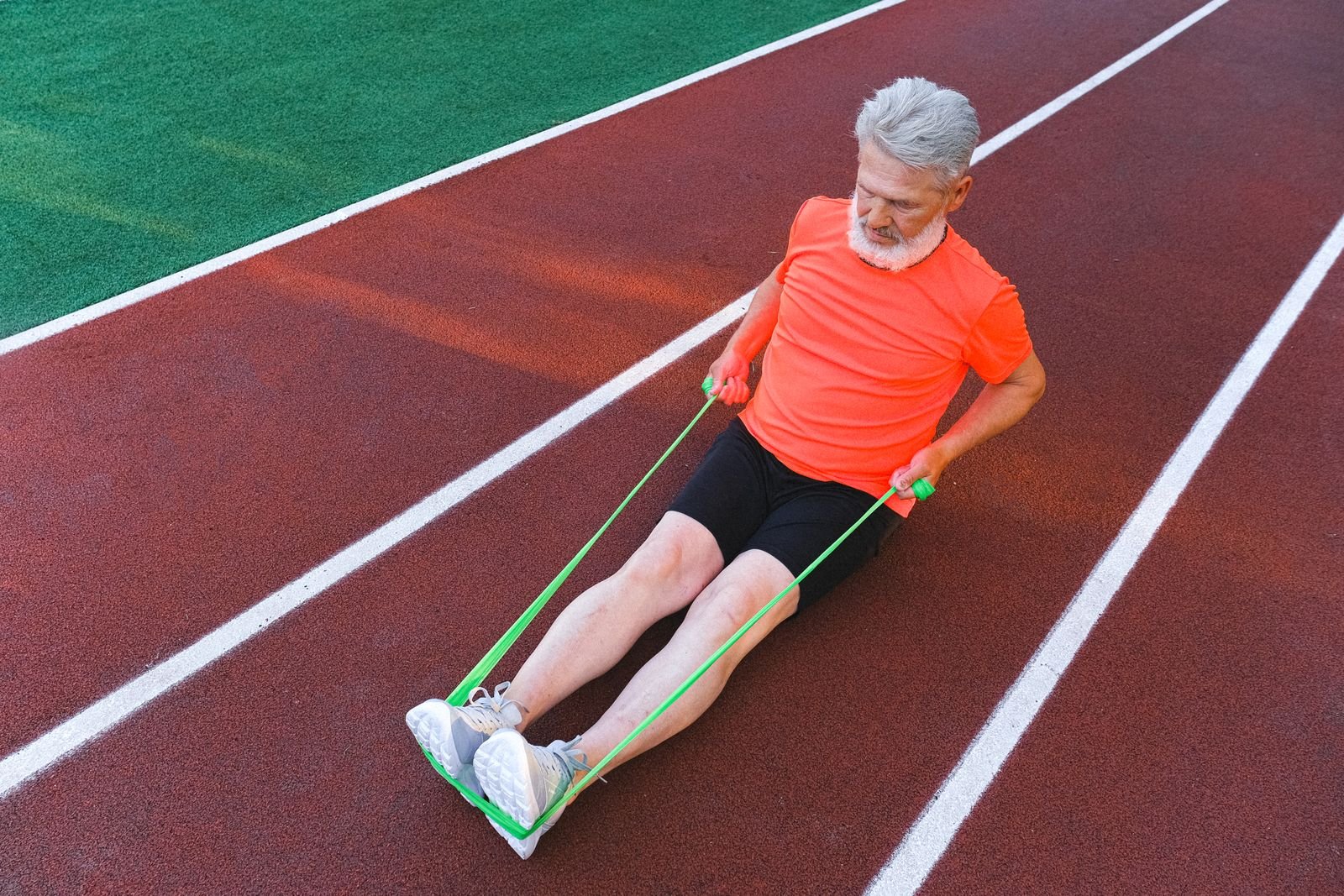
You don’t need a gym membership to start. You need a resistance band, a sturdy chair, and about 20 minutes, two to three days a week. Here’s the plan I’d give a client starting from zero.
First, lift something two or three times a week, on days that aren’t back to back. Do 1 to 2 sets of 8 to 12 reps, stopping when you have two or three good reps left in the tank. Start with these:
- Sit-to-stands from a chair, for your legs and hips. These matter most, because your thighs hold some of your biggest muscles.
- Band rows, with the band anchored in a door, to strengthen your upper back and posture.
- Wall push-ups or band chest presses. Keep your hands at a height and width that feels pain-free on your shoulders.
- Heel raises holding the counter, for your calves and balance.
- Band glute bridges or step-ups on the bottom stair, as your legs get stronger.
Second, put protein first. When the medication shrinks your appetite, it’s easy to fill up on a few crackers and call it lunch. Instead, eat the protein on your plate before anything else.
Good options include eggs, Greek yogurt, cottage cheese, fish, chicken, beans, lentils, and tofu. Ask your doctor or a registered dietitian what your daily protein target should be. That’s especially important if you have kidney disease, which is common with long-term diabetes.
Spread that protein across the day rather than saving it all for dinner. A palm-sized portion at breakfast, lunch, and dinner is easier on a quiet appetite than one big plate. If solid food feels like too much, a glass of milk, a protein shake, or a cup of Greek yogurt can fill the gap.
Third, keep walking. A short walk after meals still helps your muscles soak up sugar, and it makes the strength work feel easier over time.
Fourth, track strength, not just weight. Once a week, count how many times you can stand up from a chair in 30 seconds. If that number holds steady or climbs while the scale drops, you’re losing the right kind of weight.
You can also pay attention to everyday signs. Is carrying the laundry basket upstairs getting easier or harder? Can you open a jar without handing it to someone else? Do you need your hands to get up off the couch? Those small, honest checks tell you more about your muscle than any number on a bathroom scale.
Once the exercises start to feel easy, make them a little harder. Move to a thicker band, add a couple of reps, or slow down the lowering part of each movement to a three-count. Your muscles only hold on to what you keep asking them to do, so the challenge has to grow slowly as you do.
Finally, talk with your care team before you change anything. If you also take insulin or certain other diabetes pills, exercise can push your blood sugar lower. Your doctor may want to adjust doses or have you check your numbers around workouts. Never change your medication on your own.
Small Steps for the Days You’re Running on Empty
Let’s be real. Some days on these medications, you won’t feel great. Nausea, low appetite, and fatigue can make “go do your band workout” sound like a joke.
I’ve worked with plenty of people who felt like their body was working against them. What I’ve learned is that the all-or-nothing mindset is what usually breaks them, not the hard days themselves.
On those days, shrink the workout, don’t skip it. Do one set of sit-to-stands and one set of band rows. That’s five minutes. It still tells your muscles they’re needed.
Many people notice a pattern in how they feel across the week. If the day or two after your shot is rough, schedule your strength sessions for the days you usually feel best.
And on the days you just don’t want to, remember what I tell everyone: the only way to start when you’re not motivated is to do it anyway. Motivation shows up after you move, not before.
Here’s the bigger picture. Whatever happens with your medication down the road, the muscle you build now stays your ally. It keeps soaking up sugar after meals. It keeps you steady on the stairs. It keeps you independent.
You were handed a powerful tool. Now pair it with the one tool nobody can prescribe for you: your own effort, a few minutes at a time.
Start Protecting Your Muscle Today
If you’ve never lifted anything and don’t know where to begin, start with my free 5-Day Fit & Strong Reset. It’s a beginner-friendly PDF with five short, joint-friendly sessions you can do at home with a resistance band. It’s the perfect first step to protecting the muscle you have.
Visit SilverFitPlus.com to download it free.
If you’re already comfortable moving and ready for a gym, my paid 12-week program, Build Strong After 50, gives you a structured, progressive plan built around pain-free angles for adults over 50.
Lose the weight. Keep the muscle. Take back control.
Free 5-Day Guide
Get the Free 5-Day Fit & Strong Reset
A joint-safe, beginner-friendly start for adults over 50. Enter your email and the guide goes straight to your inbox.
No spam. Unsubscribe anytime.
Sources
- Neeland IJ, Linge J, Birkenfeld AL — “Changes in lean body mass with glucagon-like peptide-1-based therapies and mitigation strategies” — Diabetes, Obesity and Metabolism, 2024 — https://pubmed.ncbi.nlm.nih.gov/38937282/
- Mozaffarian D, et al. (ACLM, ASN, OMA, TOS) — “Nutritional priorities to support GLP-1 therapy for obesity: a joint advisory” — The American Journal of Clinical Nutrition / Obesity, 2025 — https://obesity.org/nutritional-priorities-to-support-glp-1-therapy-for-obesity
- American Diabetes Association (summary by diaTribe) — “Your Guide to the 2025 ADA Standards of Care” — diaTribe, 2025 — https://diatribe.org/diabetes-management/your-guide-2025-ada-standards-care