
If your knees, hips, or shoulders talk back every time you try to move, you’ve probably ruled out more exercise options than you’ve ever actually tried. Walking hurts by the third block. The gym floor feels unforgiving. Even reaching for something on a high shelf makes you wince.
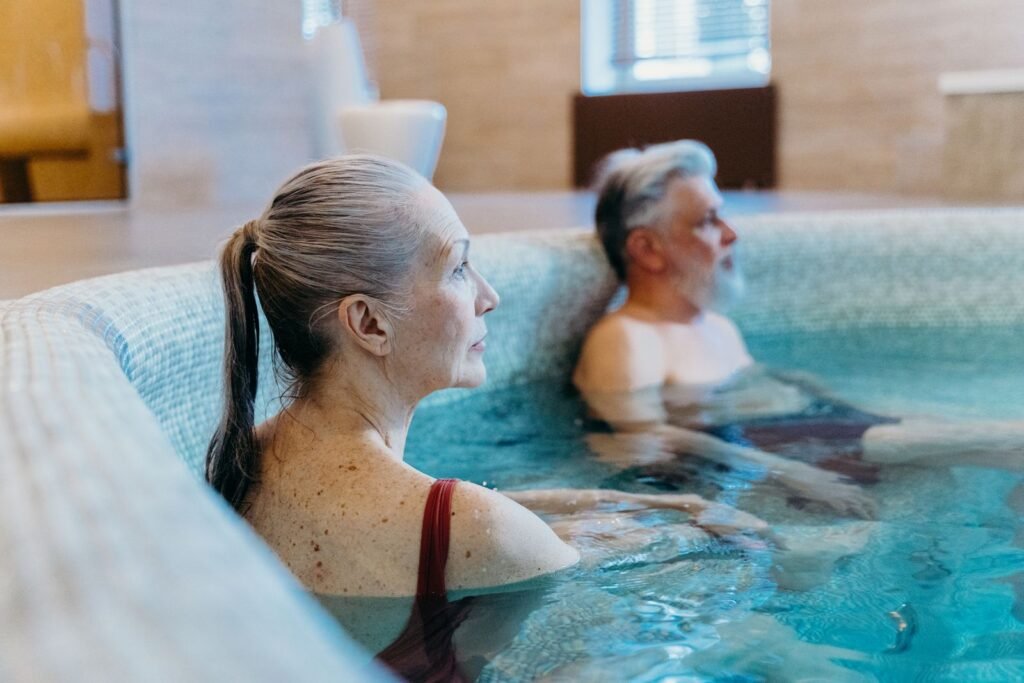
There’s a place where almost none of that happens, and it’s more accessible than you think: the pool. Not lap swimming, necessarily. Just moving in water.
You don’t need to be a swimmer. You don’t need to care what you look like in a bathing suit, though I know that stops more people than they’ll admit. You need water that comes up to your waist or chest, and about 20 to 30 minutes a few times a week.
I’ve spent 40 years training bodies, including my own through two torn rotator cuffs and bilateral shoulder arthritis. When land-based movement stopped being an option for me in my early 40s, water was one of the few places I could still load a joint without paying for it the next day. It’s not a consolation prize. For a lot of people over 50, it’s the smartest entry point back into exercise there is.
You’ve probably also gotten some version of bad advice about this already. Maybe a doctor told you to “just rest it” without ever mentioning that rest, past a certain point, is what makes an arthritic joint weaker. Maybe someone told you swimming “doesn’t really count” as exercise because you’re not sweating buckets or breathing hard. Both of those ideas are wrong, and both of them keep people sitting on the couch longer than they need to.
Why Water Takes the Weight Off Your Joints
When you stand in chest-deep water, buoyancy supports roughly 75 percent of your body weight. That means your knees, hips, and spine are carrying a fraction of what they carry when you’re upright on land.
For someone with osteoarthritis, that difference is often the reason movement stops hurting long enough to actually happen. Pain is what keeps deconditioned joints deconditioned — you hurt, so you stop moving, so the muscles around the joint weaken further, so the next attempt hurts more. Water interrupts that cycle.
A systematic review of randomized controlled trials on aquatic exercise in older adults with osteoarthritis found consistent improvements in pain, stiffness, balance, and walking ability compared to people who didn’t exercise at all, according to research published via the National Center for Biotechnology Information in 2024.
The Arthritis Foundation’s review of the evidence goes further. Across more than 750 participants studied in a comprehensive analysis, aquatic exercise produced a measurable reduction in pain — and in several trials, it outperformed land-based exercise for pain relief specifically.
That’s not a small finding. For a lot of people with arthritic joints, water doesn’t just make exercise more comfortable. It may genuinely work better.
There’s a second piece to this that doesn’t get talked about enough: warm water itself does something for sore tissue that a cold gym floor never will. The heat encourages blood flow and relaxes the muscles around a stiff joint, which is part of why a lot of arthritis sufferers say they feel looser in the water within the first few minutes, not after weeks of training.
None of this means water exercise is only for people in serious pain. It means it’s a legitimate strength and conditioning tool for anyone who’s been sedentary long enough that their joints, tendons, and stabilizing muscles need to be reintroduced to work gradually instead of all at once.
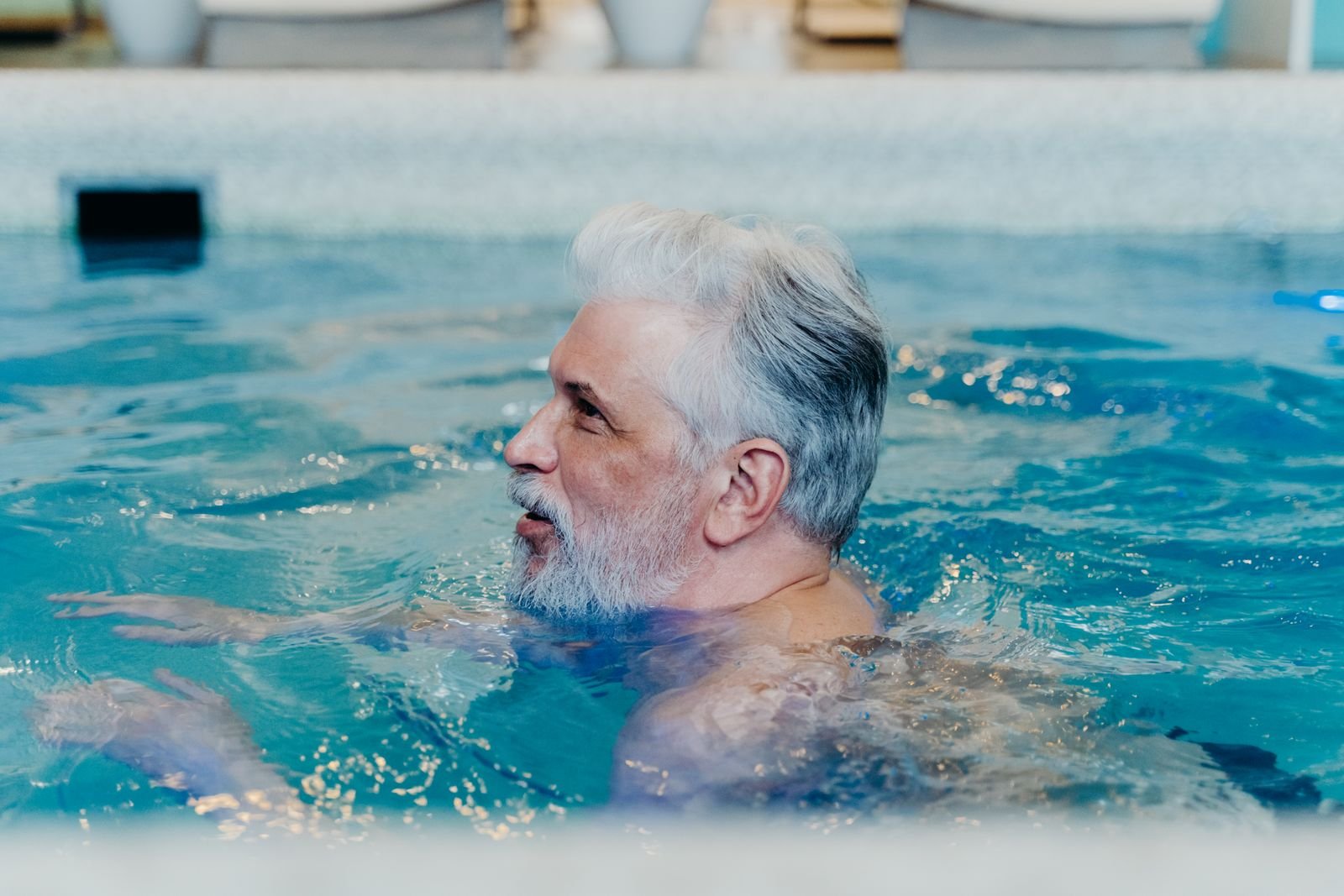
Photo by cottonbro studio on Pexels
What Water Exercise Actually Looks Like
You don’t need a special program to start. You need a few basics, and none of them are complicated.
The recommended water temperature for sore joints is between 83 and 90 degrees Fahrenheit, and most therapy pools and senior-hour public pools are kept in that range on purpose. Warm water relaxes muscle and helps you move without the guarding you’d do instinctively on land.
Waist-deep water works fine for most people just getting started. Chest-deep water offers more buoyancy, which helps if your joint pain is more severe. Aim for 20 to 40 minutes, two to three times a week, and don’t feel like you need to fill the whole session with formal exercises.
A randomized controlled trial of aquatic exercise in elderly patients with knee osteoarthritis, published in Interventional Medicine and Applied Science in 2019, found meaningful pain relief in the exercise group compared to controls using exactly this kind of program. Nothing exotic. Just consistent, water-based movement.
Think of your first two weeks as an orientation, not a workout. Get comfortable walking the pool, moving your arms and legs through a full range of motion, and getting in and out safely. Weeks three and four are where you start adding structure: a few laps of purposeful walking, some resistance work against the water, a short stretch routine at the end. By week five or six, most people are surprised at how much more they can do than when they started.
- Walking laps in the shallow end, arms swinging naturally
- Gentle leg lifts to the side or front while holding the pool wall
- Marching in place, lifting knees toward the surface
- Arm circles and shoulder presses using the water’s resistance
- Noodle-assisted stretches for hips and lower back
- Wall-supported hip extensions and gentle side steps for balance and stability
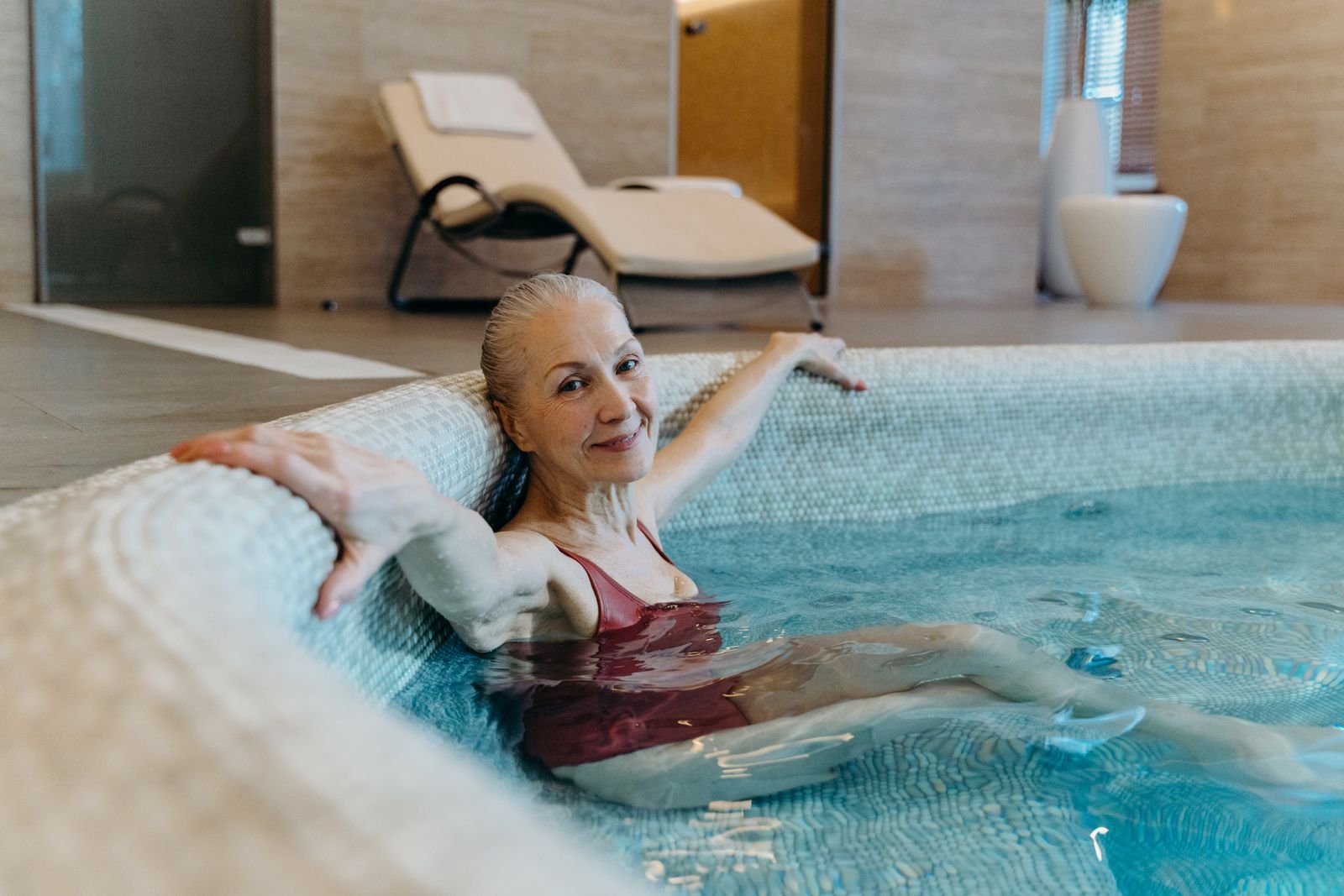
Photo by cottonbro studio on Pexels
Getting Started Without Overthinking It
Most public pools, YMCAs, and senior centers offer water aerobics or arthritis-specific aquatic classes. Call ahead and ask about accessible entry — ramps, steps, or a lift — if getting in and out is what’s actually holding you back.
If a class feels like too much right away, go alone during open swim hours and just walk the length of the pool with your arms moving. That’s a complete workout when you’re starting from zero, and nobody in the pool is paying as much attention to you as you think they are.
Water shoes help with traction on a slick pool floor, which matters more than people expect once you’re moving with any effort. A pool noodle gives you something to hold onto for stretches or balance work if you’re nervous about your footing at first.
One more thing worth knowing: research on aquatic exercise for arthritis found that higher-intensity movement in the pool — like jogging in place — produced better results than slow paddling around. You’re allowed to work at it. Buoyancy protects your joints. It doesn’t mean you have to go easy on the effort behind the movement.
Bring a friend if you can, not because you need supervision, but because showing up is easier when someone’s expecting you at the pool gate.
If the idea of putting on a bathing suit in front of strangers is the actual thing keeping you out of the water, you’re not alone, and it’s worth naming instead of letting it quietly win. Most senior and arthritis-specific swim hours are full of people your age dealing with the exact same joints, the exact same self-consciousness, and the exact same reason for being there. Nobody’s watching you as closely as you think.
When to Push and When to Pull Back
Muscle fatigue is fine. A little soreness the next day is fine — that’s your body adapting to work it hasn’t done in a while. What’s not fine is sharp pain during a movement, or joint swelling and warmth that shows up afterward.
This is where a lot of people over 50 get it backwards. You were probably raised on “no pain, no gain,” and that advice was already questionable in your twenties. After 50, especially with arthritic joints, chasing it can set you back weeks instead of days.
Water lets you find the edge of real effort without the joint-jarring impact that turns a bad rep into an actual injury on land. Use that advantage. Push your effort. Don’t push your pain.
I learned this the hard way, training through my own shoulders for years before I figured out which angles were the enemy and which ones were fine. The lesson that stuck with me is simple: pain during a movement is information, not a test of character. Adjust the movement, not your willingness to show up.
Give it four to six weeks before you judge whether this is working. Joints that have been sedentary for years don’t respond overnight, and the early sessions are often the hardest simply because your body hasn’t adapted yet. Stick with it past the point where it feels unfamiliar, and the water will start to feel less like a chore and more like the one place your body actually looks forward to moving.
You don’t have to earn the right to move without pain. Water gives you permission to start today.
You don’t have to start in a pool to start moving again, but wherever you start, the goal is the same: consistent, joint-friendly movement that rebuilds what sedentary years took away. If you want a structured way to keep building on land once you’ve found your footing in the water, Vinny’s free 5-Day Fit & Strong Reset is built exactly for this: beginner-friendly, pain-aware, and it requires nothing but a resistance band. Visit SilverFitPlus.com to download it and get moving this week.
Sources
Arthritis Foundation — “Benefits of Aquatic Exercise for Arthritis” — arthritis.org, 2025 — https://www.arthritis.org/health-wellness/healthy-living/physical-activity/other-activities/water-exercise-benefits-for-arthritis
National Center for Biotechnology Information (PMC) — “Effects of Aquatic Exercise in Older People with Osteoarthritis: Systematic Review of Randomized Controlled Trials” — PMC, 2024 — https://www.ncbi.nlm.nih.gov/pmc/articles/PMC11755622/
Interventional Medicine and Applied Science — “Randomized controlled trial of aquatic exercise for treatment of knee osteoarthritis in elderly people” — Interventional Medicine and Applied Science, Vol. 11, Issue 3, 2019 — https://akjournals.com/view/journals/1646/11/3/article-p161.xml