

You probably don’t think about your posture until something hurts. Then it’s your neck after an afternoon at the computer, or your lower back after sitting through a movie, or a dull ache between your shoulder blades that shows up around 3pm every single day.
You didn’t do anything dramatic to cause it. You just sat. For years. In a chair, at a desk, in front of a screen, and your body adapted to the position you spend the most time in — which, if you’re like most adults over 50, is slouched forward with your head drifting toward your phone or monitor.

This isn’t about standing up ramrod straight like you’re in the military. It’s about understanding what prolonged sitting is actually doing to your spine, your joints, and your long-term health — and what to do about it that doesn’t involve buying another gadget that ends up in a drawer.
Nobody warned you about this part of getting older. You spent decades building a career, raising a family, showing up — and most of that showing up happened sitting down. Now the bill is coming due in the form of a stiff neck, a nagging low back, and a posture that seems to have decided on its own how you’re going to stand. The good news is that this is one of the most fixable problems in the entire aging process, and it doesn’t require a single hour at a gym.
Why Sitting Is Doing More Damage Than You Realize
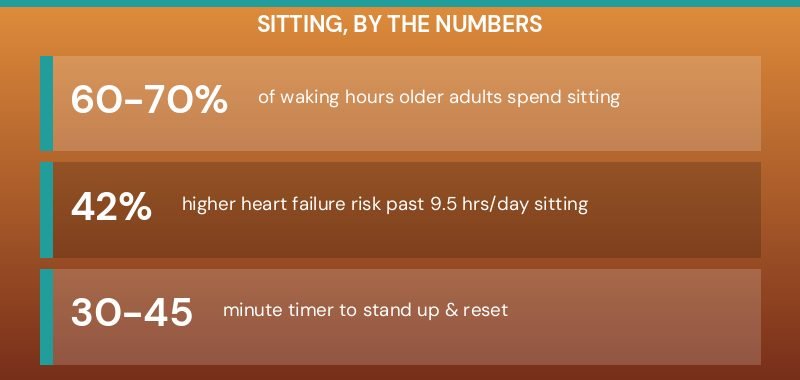
Older adults are the most sedentary age group in the country, spending an estimated 60 to 70 percent of their waking hours sitting. That’s not a moral failing — it’s how modern life for people over 50 is structured, between desk work, driving, and evenings on the couch.
But the research on what that adds up to is sobering. A 2020 study published in Circulation: Heart Failure, an American Heart Association journal, followed nearly 81,000 postmenopausal women for an average of nine years. Women who reported more than 9.5 hours a day sitting or lying down had a 42 percent higher risk of hospitalization for heart failure compared to those who sat less than 6.5 hours daily.
Here’s the part that should really get your attention: that elevated risk showed up even among women who were meeting recommended activity guidelines. In other words, a good workout in the morning doesn’t cancel out eight hours of slumping afterward. Sitting time and exercise time are two separate variables, and your body is keeping score on both.
Posture compounds the problem. A 2026 cross-sectional study in Aging Clinical and Experimental Research examined older adults and found that a more slumped sitting posture — specifically greater posterior pelvic tilt — was directly associated with chronic low back pain. The way you sit isn’t just uncomfortable in the moment. Over years, it reshapes how your spine holds itself even when you’re not sitting at all.
What’s striking about that study is where it was conducted: long-term care facilities, among older adults who’d already lost significant mobility. That’s not meant to scare you — it’s meant to show you where the road leads if slumped, sedentary posture goes unaddressed for long enough. The people in that study didn’t arrive there overnight. Their posture patterns compounded for years, the same way yours has been quietly compounding at your desk, in your car, and on your couch.
None of this is about blame. Chairs, screens, and modern life were not designed with your spine’s best interest in mind. But understanding the mechanism is what makes the fix make sense — you’re not fighting a mystery, you’re correcting a predictable pattern.
What Poor Posture Does to Your Body Over Time
When you slouch, your head — which weighs roughly ten to twelve pounds — drifts forward off your shoulders. For every inch it moves forward, the effective load on your neck and upper back muscles roughly doubles. That’s not a one-time strain. That’s a demand your neck and shoulder muscles are absorbing for hours, every day, for years.
Your hip flexors shorten from sitting for long stretches, which pulls your pelvis out of its natural position and flattens the healthy curve in your lower back. That’s part of why standing up after a long stretch at your desk can feel like your body needs a minute to remember how to be upright.
Mayo Clinic’s research on the risks of prolonged sitting also points out something adults over 50 especially need to hear: people who sit more than eight hours a day with little physical activity have a risk of premature death comparable to that associated with obesity and smoking. That’s not a scare tactic — it’s a reflection of how much your body depends on regular movement to regulate blood sugar, circulation, and metabolic health, not just muscle tone.
Your body was built to move throughout the day, not to sit for eight hours and try to make up for it with one workout.

Simple Fixes That Actually Work for a Real Schedule
You don’t need a $600 ergonomic chair or a standing desk you’ll never use consistently. You need a few habits that fit into a day you’re actually going to live.
Set a timer for every 30 to 45 minutes and stand up. The American Heart Association’s own research team behind the sedentary-time study put it plainly: breaking up sitting time doesn’t require a formal workout — standing for five minutes or marching in place at your desk is enough to interrupt the pattern that’s driving the risk.
This is genuinely the highest-leverage change available to you, and it costs nothing. You don’t need an app, a wearable, or a subscription. A basic kitchen timer or your phone’s alarm does the job. The goal isn’t to never sit — it’s to make sure your body isn’t locked in one position for the majority of your waking day, which is exactly what the research on sedentary time and heart failure risk is warning against.
Check your screen height. Your monitor or laptop should be roughly at eye level so you’re not tipping your chin down and loading your neck for hours. If you work from a laptop most of the day, a cheap stand and external keyboard fixes this for under thirty dollars.
Build a two-move reset you do every time you stand up: a doorway chest stretch to open up rounded shoulders, and a standing hip flexor stretch to undo the hours of hip flexion from sitting. Thirty seconds each, several times a day, adds up to real change over weeks.
Strengthen the muscles that hold good posture, not just the ones you feel when you slouch. Rows, rear-delt work, and glute bridges directly counteract the forward-rounded, hip-flexed position that sitting trains your body into. This is where posture stops being about willpower and becomes about actually having the strength to hold yourself upright without thinking about it.
Pay attention to your chair and your feet, too. Your hips should sit slightly above or level with your knees, and your feet should rest flat on the floor rather than dangling or tucked underneath you. If your chair doesn’t allow that, a rolled towel or small footrest solves it for a few dollars. Small, boring adjustments like this remove a lot of the strain before you ever have to think about xe2x80x9ctryingxe2x80x9d to sit up straight.
If you drive frequently, the same principles apply there. Adjust your seat so your knees are roughly level with your hips and your headrest supports the back of your skull, not just your neck. Long stretches behind the wheel are functionally identical to long stretches at a desk — your spine doesn’t know the difference between a commute and a workday.
Building a Sitting Habit You Can Actually Sustain
None of this works as a one-week fix. Your posture took years to develop, and it’ll take consistency — not intensity — to retrain.
Start with the timer. That single habit, standing every 30 to 45 minutes, is the one with the most research behind it and the lowest barrier to actually doing it. Add the stretches next. Add the strength work once the first two feel automatic.
Don’t aim for perfect posture all day. Aim for movement that interrupts the slouched position often enough that your body isn’t locked into it for eight straight hours. That’s a realistic goal, and it’s the one that actually protects your heart, your spine, and your independence over the next twenty years.
I spent plenty of years training in ways that ignored posture entirely, chasing bigger lifts while my shoulders quietly fell apart. What I’ve learned since is that the boring stuff — standing up, stretching for thirty seconds, strengthening your back — does more for how you feel every single day than almost anything flashy ever will.
Ready to build strength that supports better posture for the long haul? Check out Vinny’s Build Strong After 50, a 12-week program designed for adults 50+ who want a real, structured plan.
LaMonte, M.J., et al. — xe2x80x9cAssociation of Sedentary Time with Heart Failure Risk in Postmenopausal Womenxe2x80x9d — Circulation: Heart Failure, American Heart Association, 2020 — https://www.ahajournals.org/doi/10.1161/CIRCHEARTFAILURE.120.007508
xe2x80x9cSlumped Sitting Posture Is Associated with Chronic Low Back Pain Amongst Older Adults in Long-Term Care Facilities: A Cross-Sectional Studyxe2x80x9d — Aging Clinical and Experimental Research, 2026 — https://www.sciencedirect.com/science/article/pii/S0197457226003903
Mayo Clinic — xe2x80x9cSitting Risks: How Harmful Is Too Much Sitting?xe2x80x9d — Mayo Clinic Expert Answers — https://www.mayoclinic.org/healthy-lifestyle/adult-health/expert-answers/sitting/faq-20058005