
You don’t need a gym membership. You don’t need a rack of dumbbells or a drawer full of resistance bands. You need about twenty minutes, a clear patch of floor, and a willingness to feel a little awkward for the first few sessions. That’s genuinely it.
I’ve spent more than 40 years in this industry, and if there’s one myth I want to put to rest, it’s the idea that real strength training requires equipment. Your body weight is resistance. Standing up from a chair, pushing against a wall, lowering yourself to the floor and back up — these are the exact movement patterns that keep you independent as you age, and you can train every one of them without buying a thing.
If you’re sedentary right now, this isn’t about becoming an athlete. It’s about giving your muscles a reason to stay strong, so the ordinary tasks of your life — carrying groceries, climbing stairs, getting up off the floor when the grandkids pull you down there — stay ordinary instead of becoming the thing you dread.
Why Your Own Body Weight Is Enough
Here’s what nobody tells you when they’re trying to sell you fancy equipment: resistance is resistance. Your muscles don’t know the difference between a 10-pound dumbbell and the equivalent weight of your own forearm and torso moving against gravity. What matters is that the muscle works against a load it isn’t used to, repeatedly, over time.
This matters even more after 50, when a condition called sarcopenia — the slow, silent loss of muscle mass and strength — starts working against you if you aren’t doing anything to interrupt it. Left unaddressed, sarcopenia doesn’t just cost you strength. It costs you balance, bone density, and your ability to bounce back from a fall, a hospital stay, or even a bad flu without losing a step of independence.
A systematic review and meta-analysis published in Aging Clinical and Experimental Research examined resistance training protocols specifically in older adults diagnosed with sarcopenia. Structured training — including bodyweight and elastic band methods — reliably improved muscle strength, physical function, and lean muscle mass across the studies reviewed. One randomized controlled trial included in that body of research had older women perform bodyweight and elastic band resistance training three times a week for 16 weeks. Researchers described it as a safe, portable, and effective way to improve neuromuscular function in this population — no gym or machines required.
You don’t need to chase soreness or exhaustion to get these benefits. You need to show up and do the work consistently. That’s the whole secret. It’s less exciting than an ad for a home gym, but it’s what actually rebuilds you.
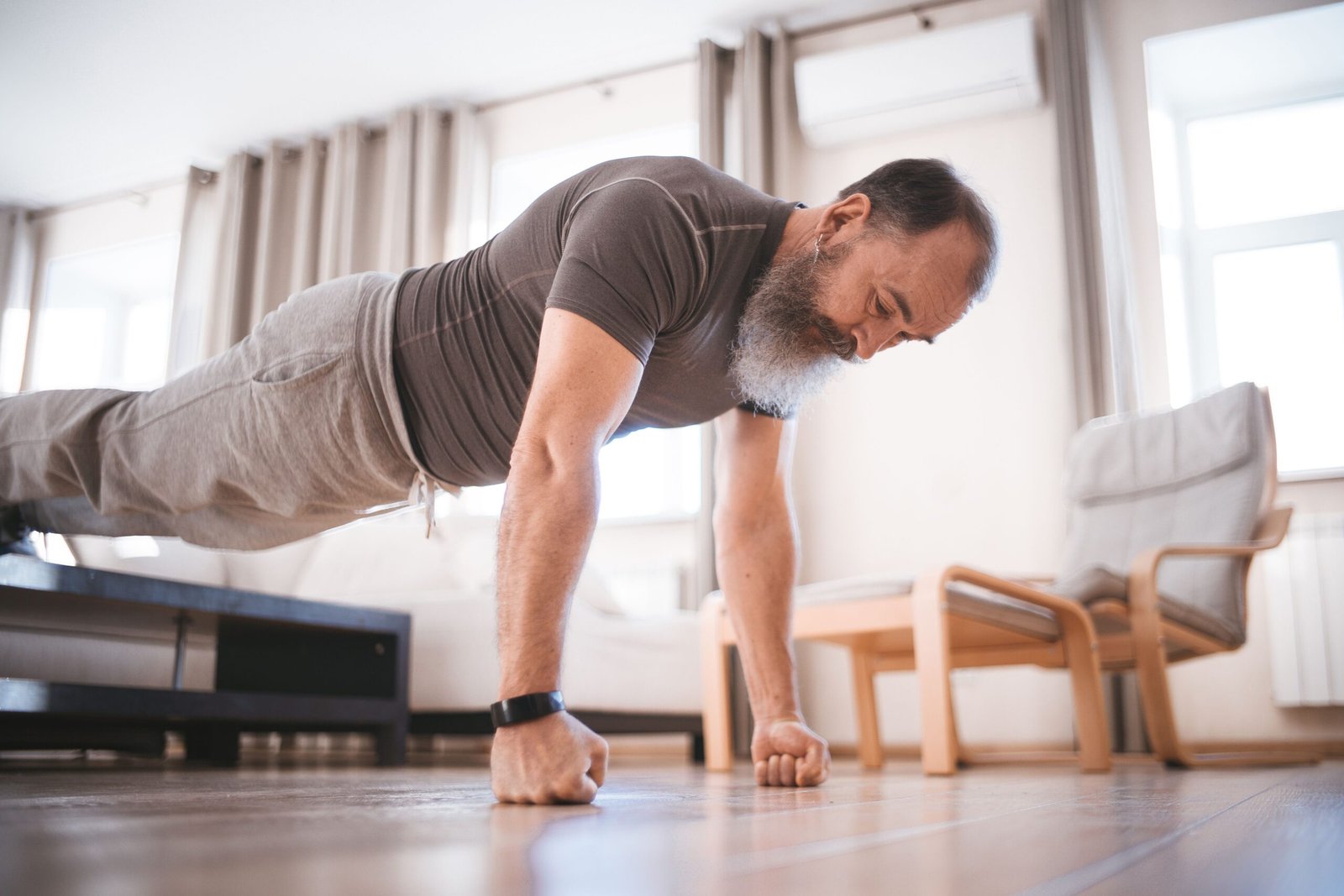
The Five Movements That Cover Your Whole Body
You don’t need twenty different exercises. You need a handful of movement patterns done well and done consistently. Here are the five I give every beginner, regardless of where they’re starting from.
- Sit-to-stand: From a sturdy chair, stand up without using your hands, then sit back down with control. This is the single most functional exercise you can do — it’s the movement behind every time you get out of bed, off the toilet, or out of a car.
- Wall push-up: Stand arm’s length from a wall, hands flat against it at shoulder height, and lower your chest toward the wall, then push back. It trains your chest, shoulders, and arms without the shoulder strain of a floor push-up.
- Standing row with a towel: Loop a towel around a sturdy door handle or stair railing, lean back slightly with arms extended, and pull your chest toward your hands. This works your back and counters the forward hunch so many of us develop from decades of sitting.
- Step-ups: Using the bottom stair of your staircase, step up with one leg, then the other, then step back down under control. This builds the single-leg strength and balance that prevents falls.
- Glute bridge: Lying on your back with knees bent and feet flat, lift your hips toward the ceiling and squeeze, then lower with control. This strengthens the muscles that support your lower back and hips.
Start with one set of 8 to 10 repetitions of each movement. That’s the whole workout. You’re not training for a competition. You’re teaching your body to move well again, one honest repetition at a time.
You don’t need a gym to get strong again. You need to stop waiting for permission to start.

How to Start When Your Body Feels Like It Forgot How
I understand what it’s like to have a body that doesn’t cooperate the way it used to. In my early 40s, I developed bilateral shoulder arthritis and tore both rotator cuffs. I went from decades of heavy training to barely being able to lift my arms overhead without real pain. I stopped training entirely for years because every version of exercise I knew hurt.
What brought me back wasn’t toughing it out. It was learning to train at pain-free angles — finding the specific range of motion where a movement worked with my joints instead of against them. If a wall push-up bothers your shoulder, place your hands lower on the wall. If a step-up bothers your knee, use a lower step or hold a railing for support while you build confidence. The goal isn’t to perform the textbook version of an exercise on day one. The goal is to find a version your body can do today, and build from there.
This matters even more if you’re sedentary and haven’t trained in years, or ever. Your joints, tendons, and nervous system all need time to relearn these patterns safely. Rushing this stage is how people get discouraged, sore in the wrong way, and quit in the first two weeks. Going slow at the beginning isn’t weakness. It’s strategy, and it’s the difference between a program you stick with and one you abandon by February.
If something sends a sharp, specific pain into a joint, stop and modify the movement or skip it that day. General muscle fatigue is expected. Joint pain is your body asking you to change the angle, not push through.
When It Starts to Feel Easy: How to Progress Without Equipment
Eventually, 8 to 10 repetitions of these five movements will start to feel manageable, even easy. That’s a good problem to have, and it doesn’t mean you need to run out and buy equipment. It means it’s time to make your own body weight work harder.
You can slow the tempo down, taking three or four full seconds to lower into each movement instead of just dropping into it. You can add repetitions, working up toward two or three sets instead of one. You can change your base of support, moving from a wall push-up to a countertop push-up, which is a steeper angle and asks more of your chest and arms. You can also add single-leg variations, like holding your sit-to-stand at the bottom for a two-count before standing back up, which challenges your balance and control even further.
Progress doesn’t have to be dramatic to be real. Small, steady increases in difficulty, spread out over weeks and months, are exactly how the body adapts safely. This is also where a lot of well-meaning people go wrong. They either never progress at all and plateau, or they progress too fast and get hurt. Somewhere in the middle, done consistently, is where the results live.
Turning This Into a Habit, Not a One-Time Effort
None of this works if you do it once and call it done. The research on resistance training in older adults is consistent on this point: the benefits come from sustained, structured effort over months, not from a single burst of motivation on a Monday morning.
So here’s what I tell every new client. Attach this to something you already do without thinking about it. Do your five movements right after you brush your teeth in the morning, or right before you sit down for dinner. Put a sticky note on the bathroom mirror. Set a recurring phone alarm labeled “20 minutes for you.” The goal in the first month isn’t intensity. It’s showing up on the days you don’t feel like it, especially those days.
The Centers for Disease Control and Prevention recommends that adults 65 and older get at least two days a week of muscle-strengthening activity that works all the major muscle groups, along with activities that improve balance. Two days a week. That’s a realistic, achievable target, and this five-movement routine gets you there without a single trip to a gym or a single dollar spent on equipment.
You will have days where twenty minutes feels like too much. Do ten minutes instead. You’ll have days you don’t want to start at all. Start anyway, even if it’s just the sit-to-stands. Motivation is unreliable and it always has been. Consistency, even imperfect consistency, is what actually rebuilds you.
If you’re ready to put this into a real, guided plan, grab my free 5-Day Fit & Strong Reset, a beginner-friendly program that walks you through exactly what to do each day, using nothing more than a resistance band and your own body weight. Visit SilverFitPlus.com to download it and get started today.
Sources
- Kim, H., et al. — “Optimal resistance training prescriptions to improve muscle strength, physical function, and muscle mass in older adults diagnosed with sarcopenia: a systematic review and meta-analysis” — Aging Clinical and Experimental Research, 2025 — https://link.springer.com/article/10.1007/s40520-025-03235-w
- “Effects of 16 Weeks of Resistance Training on Muscle Quality and Muscle Growth Factors in Older Adult Women with Sarcopenia: A Randomized Controlled Trial” — 2021 — https://www.ncbi.nlm.nih.gov/pmc/articles/PMC8267934/
- Centers for Disease Control and Prevention — “What Counts as Physical Activity for Older Adults” — Physical Activity Basics, CDC — https://www.cdc.gov/physical-activity-basics/adding-older-adults/what-counts.html