

If you’ve been told you have prediabetes or type 2 diabetes, you’ve probably been handed a list of foods to cut. Less bread. Less rice. Less pasta. Fewer potatoes. And if you’re like most people, you tried for a while, felt deprived, and slid back to eating the way you always have.
I’m not going to hand you another list of things to give up today. I’m going to show you something that asks almost nothing of you, and it’s backed by real research. Same plate. Same food. Different order.
Eat your vegetables first, your protein second, and your starches last. That’s it. It sounds too simple to matter. But when researchers have actually measured blood sugar after meals eaten in different orders, the difference has been big enough to take seriously.
I’ve spent more than 40 years around fitness, and one thing I’ve learned is that the habits that stick are the ones that fit into your life, not the ones that fight it. This one fits. You can do it at your kitchen table tonight.
What Food Order Actually Does to Your Blood Sugar
In 2015, a team at Weill Cornell Medicine led by Dr. Alpana Shukla published a study in Diabetes Care that got a lot of attention. They took adults with type 2 diabetes, average age about 54, and fed them the same meal on two different days: chicken, salad with vegetables, bread, and orange juice.
On one day, participants ate the carbohydrates first and the protein and vegetables 15 minutes later. On the other day, they reversed it. Protein and vegetables first, carbs 15 minutes later.
When the carbs came last, blood sugar was about 29% lower at 30 minutes, 37% lower at 60 minutes, and 17% lower at two hours. Insulin levels were lower too. Same food, same amount, same people. The only change was the order.
Why does this work? When you eat fiber and protein first, they slow down how fast your stomach empties into your small intestine. So when the starch arrives, it trickles into your bloodstream instead of flooding it. Protein also helps trigger gut hormones, including GLP-1, that help your body handle the sugar that’s coming. It’s the same hormone some of today’s popular diabetes medications are designed to mimic.
Think of it like merging onto a highway. If a hundred cars hit the on-ramp at once, you get a jam. If they come in steadily, traffic flows. Your vegetables and protein are the traffic light that meters the flow.
The Research Holds Up in Prediabetes, Too
That first study was small, just 11 people. So it’s fair to ask whether it was a fluke. It wasn’t the only one.
In 2018, Shukla’s team tested food order in 15 adults with prediabetes, published in Diabetes, Obesity and Metabolism. Eating protein and vegetables before carbohydrates cut the peak blood sugar spike by more than 40% compared with eating carbs first. The overall blood sugar rise over three hours was nearly 39% lower.
Just as important, when people ate carbs first, their blood sugar bounced up and down sharply. When they ate carbs last, it stayed steady. Those swings matter. Big spikes followed by crashes are part of what leaves you tired, foggy, and hungry again an hour after eating.
Then there’s the long view. Researchers in Japan led by Dr. Saeko Imai have studied this for years. Their work, published in the Journal of Clinical Biochemistry and Nutrition in 2014, found that people with type 2 diabetes who ate vegetables before carbohydrates had lower after-meal blood sugar in the short term and improved long-term blood sugar control that held up over two and a half years.
Two and a half years. That’s not a crash diet result. That’s a habit that lasts, because it’s easy enough to keep doing.
What I like most about this research is who it applies to. These weren’t elite athletes or people on strict meal plans. They were ordinary adults, many of them middle-aged and older, eating ordinary food. If it worked at their tables, it can work at yours.
You don’t have to eat perfectly to eat smarter. Sometimes the smartest change is simply what goes into your mouth first.
I want to be honest about the limits. These are small studies, and food order won’t cure diabetes on its own. But when it comes to lifestyle changes, it’s hard to find one that costs you less and asks for so little willpower.

How to Eat in Order at Real Meals
This is where people get stuck, because real meals aren’t lab meals. Nobody serves dinner in three separate courses with 15 minutes between them. You don’t need to. Here’s how to make it work in the real world.
The basic pattern looks like this:
- Start with the vegetables or salad on your plate. Eat most of them before anything else.
- Move to your protein next: chicken, fish, eggs, beans, lean beef, tofu, or Greek yogurt.
- Save the starch for last: the rice, potatoes, bread, pasta, or tortillas.
- Eat slowly. Even a 10-minute gap between veggies and carbs gives your body a head start.
- Leave dessert or fruit juice for the very end, if you have it at all.
At restaurants, this is easier than you’d think. Ask for the salad or vegetable side first. Push the bread basket to the far side of the table until your main course arrives, then have a piece with the tail end of the meal if you still want it. Most of the time, you’ll find you want less of it.
At breakfast, start with eggs, cottage cheese, or Greek yogurt before the toast or oatmeal. Even a few bites of protein first can help.
With mixed dishes like stir-fry, casseroles, or sandwiches, you can’t separate everything, and that’s fine. Pick out the vegetables and meat first where you can. For a sandwich, eat a side salad or some raw veggies before you start on it. Perfect isn’t the goal. Better is the goal.
A quick word on what goes in which group, because this trips people up. Non-starchy vegetables are your first course: leafy greens, broccoli, cauliflower, green beans, zucchini, peppers, tomatoes, mushrooms. Corn, peas, and potatoes act more like starches, so they belong at the end with the bread and rice. Beans and lentils are a bit of both. They carry protein and fiber along with their carbs, which is part of why they’re such a good choice to begin with.
Here’s what a typical weeknight dinner might look like. Say it’s grilled chicken, green beans, and a baked potato. Start with the green beans. Then eat most of the chicken. Finish with the potato. If you’re still hungry after that, have a little more of the vegetables rather than a second potato. You haven’t cut anything out. You’ve just changed the batting order.
Don’t be surprised if you feel fuller, too. When fiber and protein go in first, your appetite often settles down before the starch even arrives. Many people naturally eat a smaller portion of carbs this way, without ever feeling like they’re dieting.
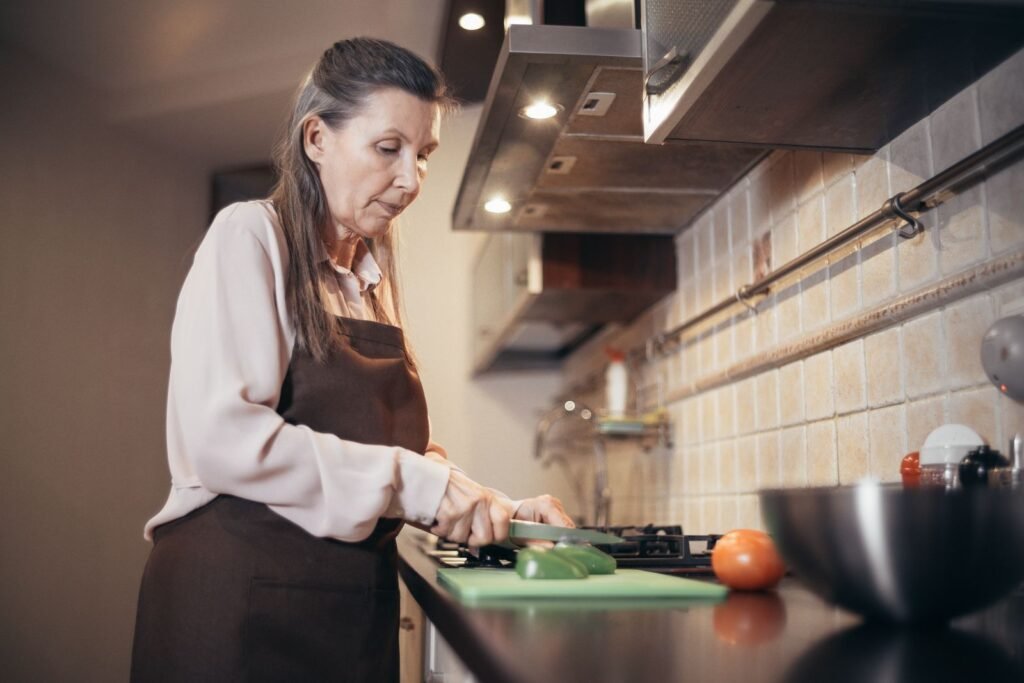
One more practical tip: keep pre-cut vegetables ready in the fridge. Baby carrots, cucumber slices, bell pepper strips, snap peas. If the vegetables are ready, eating them first becomes the path of least resistance.
What Food Order Can’t Do, and What to Pair It With
Let me be straight with you. Food order is not a license to eat a mountain of white rice as long as you eat a carrot first. Portion size and food quality still matter. If you’re eating far more carbohydrates than your body can handle, order alone won’t save you.
Think of food order as one tool in the toolbox, and it works best alongside the two others that I believe matter most: moving after meals and building muscle.
A short walk after eating helps your muscles pull sugar out of your blood. And muscle itself is your body’s biggest storage tank for blood sugar. The more of it you have, the more room there is for glucose to go somewhere besides your bloodstream. That’s why I push strength training so hard for anyone dealing with blood sugar problems. I came back from serious muscle loss in my 60s, and I felt the difference in my energy after meals once my muscle came back.
So here’s a simple stack to start with tonight:
- Eat your vegetables first, protein second, carbs last.
- Take a 10-minute walk after your biggest meal of the day.
- Do two or three short strength sessions a week to build your glucose storage tank.
One important safety note: if you take insulin or medications that can drop your blood sugar, such as sulfonylureas, talk with your doctor before changing how you eat. Lower spikes are a good thing, but your medication may need adjusting, and you don’t want to overshoot into a low.
You don’t need to overhaul everything at once. You don’t need to give up every food you love. Tonight, eat your vegetables first. Tomorrow, do it again. The only way to start when you’re not motivated is to do it anyway, and this is about as easy a start as you will ever get.
Want to build the muscle that helps your body manage blood sugar? Check out Build Strong After 50. It lays out a simple, joint-friendly 12-week plan for adults over 50 who are ready to get stronger, step by step.
Sources
- Shukla AP, Iliescu RG, Thomas CE, Aronne LJ — “Food Order Has a Significant Impact on Postprandial Glucose and Insulin Levels” — Diabetes Care, 2015 — https://pmc.ncbi.nlm.nih.gov/articles/PMC4876745
- Shukla AP, et al. — “The impact of food order on postprandial glycaemic excursions in prediabetes” — Diabetes, Obesity and Metabolism, 2018 — https://pubmed.ncbi.nlm.nih.gov/30101510/
- Imai S, et al. — “Effect of eating vegetables before carbohydrates on glucose excursions in patients with type 2 diabetes” — Journal of Clinical Biochemistry and Nutrition, 2014 — https://pmc.ncbi.nlm.nih.gov/articles/PMC3882489/