

You know the moment. The alarm goes off, you swing your feet toward the floor, and your body files a complaint. Your knees feel welded shut. Your hips don’t want to bend. Your hands curl like you slept in a vise. Then you shuffle to the bathroom, and somewhere around the second or third trip across the house, things start to loosen up.
If that is your daily start, you are in very large company. And if it has convinced you that your body is “just too old” to exercise, I want to change your mind this morning. I have lived in that stiff body. Bilateral shoulder arthritis and torn rotator cuffs taught me that how you treat the first ten minutes of your day shapes the other sixteen hours.
What Is Actually Happening While You Sleep
Here is the plain-English version. Your joints are lubricated by a thick fluid that gets squeezed around when you move. Overnight, you hold still for six, seven, eight hours. The fluid settles, the surrounding muscles and tendons tighten, and the joint wakes up feeling like a hinge that hasn’t been oiled.
Harvard Health Publishing, in a piece by Dr. William Kormos, explains that cartilage tends to dry out and stiffen with age, and the joint lining makes less of that lubricating fluid. Weak muscles and stiff tendons tighten during sleep, too. Osteoarthritis (wear and tear) and rheumatoid arthritis (inflammation) can both add to the problem.
Now the part that matters most: the same article notes that the average episode of morning stiffness lasts about 10 to 15 minutes and eases as you move and warm up. Stiffness tied to rheumatoid arthritis can last more than an hour. That gives you a simple yardstick. Fifteen minutes of creaky is common. A full hour, or stiffness with swelling and heat in the joint, is something to bring to your doctor.
The takeaway is this. Stiffness is not a stop sign. For most of us, it is a signal that the joint needs motion to get its own lubrication moving again.
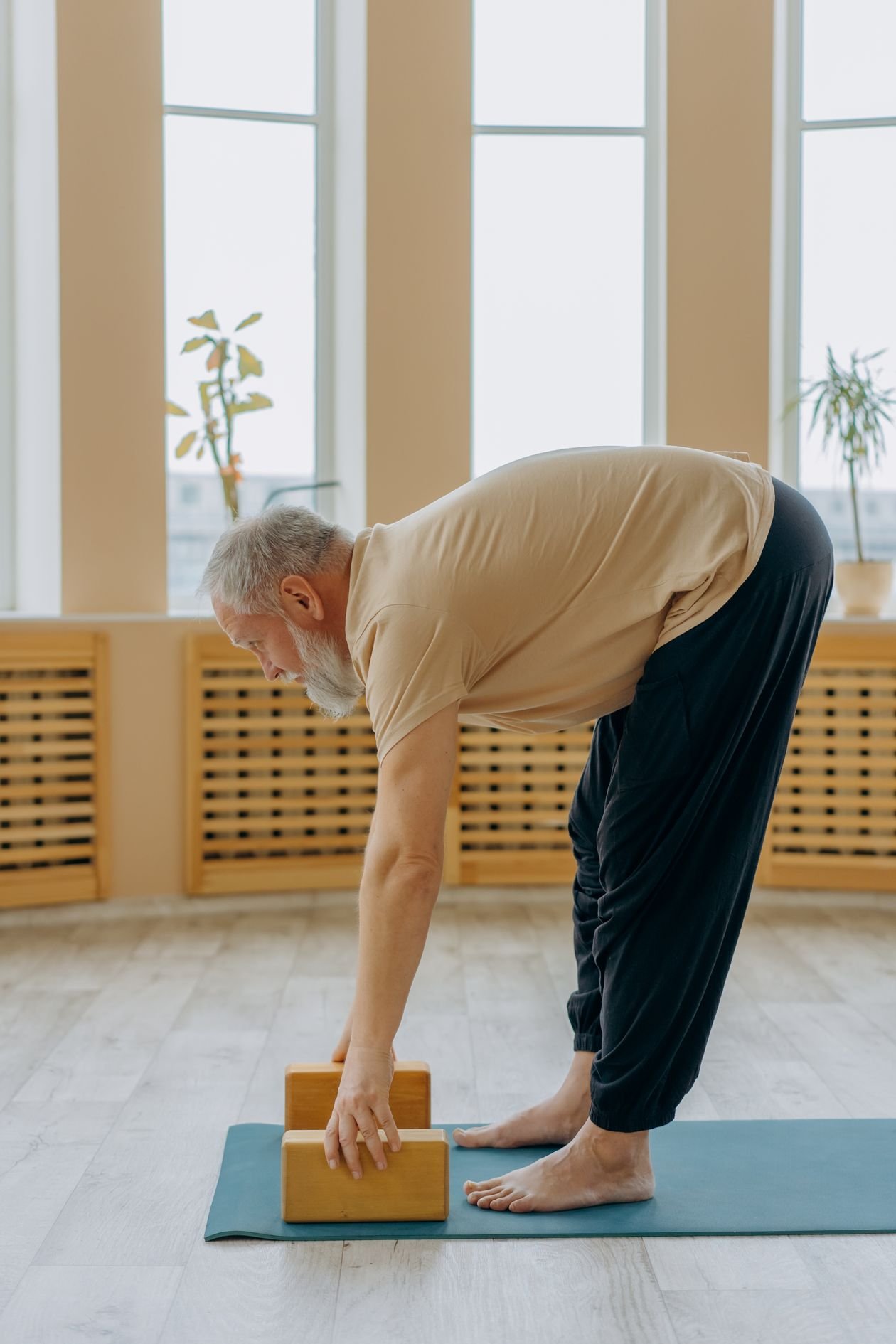
Warm It Up Before You Move It
Think of a cold stick of butter. Try to bend it and it cracks. Warm it a little and it gives. Your tissues behave in a similar way, and that is why heat is such an old and trusted tool for morning stiffness.
The Arthritis Foundation, in its article “Heat Therapy Helps Relax Stiff Joints” (December 2025), lists several easy options: a warm shower in the morning to ease stiffness and improve range of motion, a warm bath or pool, an electric heating pad on the hip, back, shoulder, or knee before stretching, or a moist heat pad made by microwaving a wet washcloth in a freezer bag. They suggest about 20 minutes for a warm compress, and describe a healthy bath temperature as 92 to 100 degrees.
A few cautions are worth taking seriously, and the Foundation spells them out. Skip heat during an acute injury or flare-up. If a joint is suddenly swollen and red, cold is the better choice for a few days. Keep the water less hot if you have heart problems, drink water before and after a warm soak, and don’t jump straight from hot to cold. If you have a heart condition, diabetes, or any numbness in your skin, check with your doctor before using heat.
For most people reading this, the simplest plan is the best one. Stand under a warm shower for a few minutes, let the heat soak into your shoulders and lower back, and then do your routine below while you are still warm. If a shower isn’t realistic, a heating pad on your lap while you sit on the edge of the bed works nearly as well.
Stiffness is not a stop sign. It is your body asking for motion, and motion is the one thing you can give it for free.

The 5-Minute Bed-to-Kitchen Routine
This is the routine I wish someone had handed me when I was sitting on the couch afraid to move. Nothing in it hurts. Nothing in it needs equipment. Move slowly, breathe, and stay inside a range of motion that feels comfortable. If something pinches, back off until it doesn’t.
- Ankle pumps (30 seconds): Lying down or sitting on the edge of the bed, point your toes away, then pull them toward you. This wakes up the circulation in your lower legs.
- Knee hugs (30 seconds each side): Lying on your back, gently draw one knee toward your chest with both hands behind the thigh, then switch. Stop when you feel a mild stretch, not a pinch.
- Gentle knee rocks (30 seconds): Lying on your back with both knees bent, let your knees fall softly to one side, then the other. This eases the lower back and hips.
- Hand openers (30 seconds): Make a soft fist, then spread your fingers wide. Repeat slowly. If your knuckles are touchy, take it easy and use less force.
- Shoulder slides (30 seconds): Sitting up, slide your hands up your thighs and let your shoulders roll back. Skip lifting your arms overhead if that angle bothers you. Pain-free angles only. That rule brought me back to training.
- Sit-to-stand (5 to 8 slow reps): From the edge of the bed or a sturdy chair, stand up, pause, and sit back down with control. Use your hands for support if you need it.
A quick note on pace. Count to three on every movement instead of rushing, and keep your breathing smooth. If you catch yourself holding your breath, you are going too hard. The goal is to coax the joints open, not to force them.
That is it. Five minutes, give or take. By the time you finish, your joints have been moved through their paths, your blood is flowing, and your muscles have started to share the load.
A word to anyone thinking this is too small to matter. When you are starting from the couch, small is the point. A routine you will do tomorrow beats a perfect one you will skip. My motto holds here too: the only way to start when you are not motivated is to do it anyway. And this one is five minutes, so the bar is low enough to step over.
Give it two weeks before you judge it. In the first few days, you may not feel much difference. Somewhere in the second week, many people notice that the creaky stretch between the bed and the coffee pot gets shorter. Keep a simple note on your phone: how long did it take to feel loose today? Watching that number shrink is its own kind of motivation.
What the Research Says About Moving Through It
If you have been told to rest your achy joints, here is some evidence worth passing along to whoever told you that. A Cochrane review led by Marlene Fransen and colleagues, “Exercise for osteoarthritis of the knee” (2015), pooled data from dozens of trials. For pain, the review reported high-quality evidence that exercise reduced knee pain right after treatment, by roughly 12 points on a 0 to 100 scale compared with no exercise. For physical function, moderate-quality evidence showed an improvement of about 10 points.
Those benefits were smaller, but still present, two to six months after supervised treatment ended. That tells us something honest: the gains don’t last unless you keep moving. Think of exercise as a subscription, not a one-time purchase.
Harvard’s piece reaches a similar conclusion in plain language. Being more active and building muscle strength and flexibility can reduce how often and how severely stiffness occurs. Maintaining a healthy weight helps too. The same piece adds that glucosamine and chondroitin supplements don’t appear to help symptoms over the long term, so you can save your money on that front.
I am not telling you stiffness disappears. I still have mornings when my shoulders announce themselves before my eyes are fully open. What changed is that I stopped treating those mornings as a verdict. I treat them as a warm-up cue.
When to Stop and Call Your Doctor
Moving through stiffness is different from moving through damage. Learn the difference, because it protects you.
- Stiffness that regularly lasts longer than an hour after waking.
- A joint that is swollen, red, or hot to the touch.
- Sharp or catching pain that gets worse as you move instead of easing.
- Sudden loss of grip, strength, or motion in a joint that was working fine last week.
- Morning stiffness that is new and shows up in several joints at once.
Any of these is a reason to get checked out before you push further. A good doctor or physical therapist can tell you whether you are dealing with ordinary age-related stiffness or something inflammatory that needs different treatment. Getting that answer is not a setback. It is how you make the rest of your plan safe.
Tomorrow morning, try this: set a timer for five minutes, run the routine, and notice how you feel at minute six. Not perfect, probably. But looser, and that is a win you can build on. Do it for a week and see what changes.
Ready for a simple next step? Grab the free 5-Day Fit & Strong Reset, a beginner-friendly PDF built around a resistance band and pain-free movement. Visit SilverFitPlus.com to download it. Prefer the gym? The free Build Strong: 12-Week Gym Program Overview is there too.
Sources
William Kormos, MD (Harvard Health Publishing) — “What makes my joints stiff in the morning?” — Harvard Men’s Health Watch, 2016 — https://www.health.harvard.edu/pain/what-makes-my-joints-stiff-in-the-morning
Marlene Fransen, Sara McConnell, Alison R. Harmer, Martin Van der Esch, Milena Simic, Kim L. Bennell — “Exercise for osteoarthritis of the knee” — Cochrane Database of Systematic Reviews, 2015 — https://doi.org/10.1002/14651858.CD004376.pub3
Arthritis Foundation — “Heat Therapy Helps Relax Stiff Joints” — arthritis.org, December 2025 — https://www.arthritis.org/health-wellness/healthy-living/managing-pain/pain-relief-solutions/heat-therapy-helps-relax-stiff-joints