
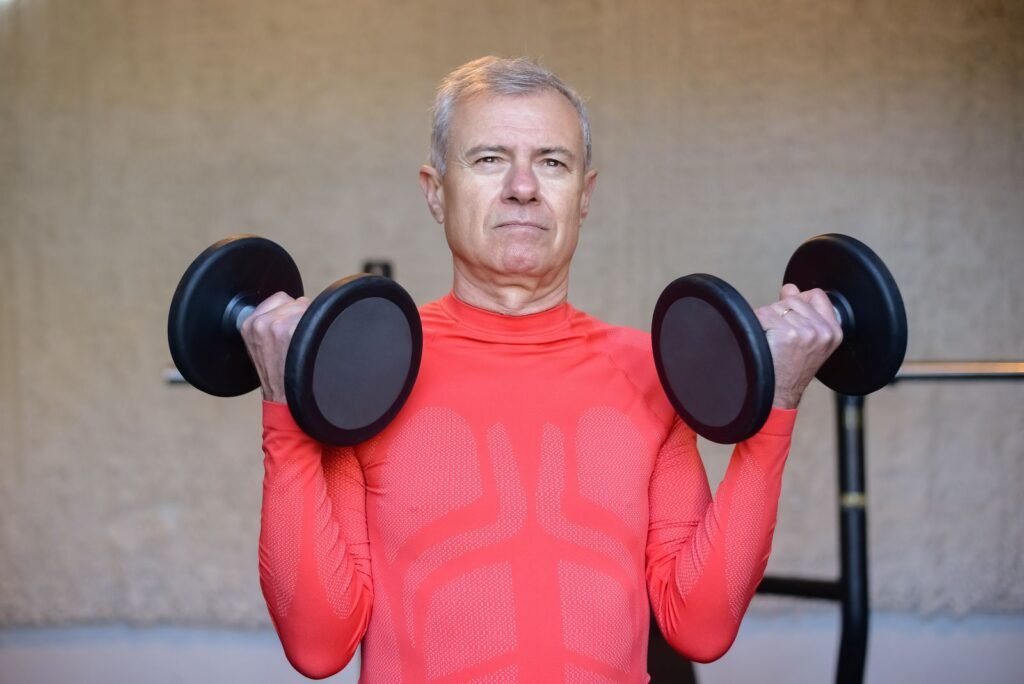
When most people think about protecting their memory, they think about puzzles. Crosswords, word games, brain-training apps. Something you do sitting down.
When most people think about lifting weights, they think about muscles. Arms, legs, maybe their bones if their doctor has mentioned it.
Very few people put those two things together. But some of the most interesting research on aging brains over the last fifteen years says they belong together. Getting stronger may be one of the better things you can do for the way you think, plan, and remember.
Puzzles aren’t useless. But they train the skill of doing puzzles. What the research below suggests is that the body you carry around every day may have a bigger say in how your brain ages than most of us were ever told.
I started lifting at 14, and for most of my life I thought of it as body work. It took a long layoff, a lot of reading, and my own comeback in my 60s to see it differently. If you’ve never touched a weight, or you haven’t in decades, this one is for you.
What Lifting Did for Women in Their 60s and 70s
In 2010, Dr. Teresa Liu-Ambrose and her team at the University of British Columbia published a study in the Archives of Internal Medicine. They took women aged 65 to 75 and put them on a resistance training program, once or twice a week, for a full year.
These weren’t athletes. They were ordinary older women. And after twelve months of lifting, they showed improvements in what scientists call executive function.
That’s not a small thing. Most people assume that by their late 60s, the brain is only going one direction. This study suggested that a modest, regular strength routine could push back against that.
Executive function is the brain’s management team. It’s what lets you plan a grocery trip, keep track of your medications, follow a conversation while the TV is on, and switch from one task to another without losing the thread. It’s also one of the abilities most closely tied to living on your own as you age.
The researchers noted something else, too. The women’s walking speed improved, and walking speed is one of the strongest everyday predictors of health and survival in older adults.
Here’s what I want you to notice. This wasn’t a seven-day-a-week program. Once or twice a week was enough to make a difference. That’s a dose almost anyone can find time for.
Stronger Legs, Sharper Mind: The SMART Trial
A few years later, researchers in Australia ran a trial that pushed the question further. It was called the SMART study, and it included 100 adults between 55 and 86 who had mild cognitive impairment. That’s the stage where memory and thinking have started to slip, but daily life is still mostly intact. For many people, it’s a warning sign of what could come next.
Participants did supervised progressive resistance training two to three times a week for six months. “Progressive” is the key word. As they got stronger, the weights went up.
In the 2016 analysis published in the Journal of the American Geriatrics Society, led by Dr. Yorgi Mavros, the people who gained the most strength showed the biggest improvements in overall cognition. And here’s the part that surprised a lot of people: it was the strength gains, not improvements in aerobic fitness, that tracked with the brain benefits. Lower-body strength in particular was linked to better scores.
The cognitive gains also lasted. The researchers found the benefits were still there a full year after the supervised sessions ended.
Think about what that means for someone who has just been told their memory isn’t what it used to be. Instead of only being handed a pamphlet and a follow-up appointment, there’s something active they can do, two or three times a week, that has real evidence behind it.
I want to be careful here. This kind of study shows a strong link between getting stronger and thinking better. It doesn’t prove exactly how muscle talks to the brain, and the scientists themselves say more work is needed. But when the evidence keeps pointing the same direction, it’s worth paying attention.
You don’t have to choose between a strong body and a sharp mind. Every rep you do is working on both.
Your Grip Is Telling on You
If the trials show that getting stronger helps, the big population studies show what happens when we let strength slide.
In 2022, a team led by Irene Esteban-Cornejo looked at data from more than 466,000 people in the UK Biobank and followed them for about nine years. They measured something simple: grip strength.
People in the weakest group had a 72% higher risk of developing dementia than people in the strongest group, even after the researchers accounted for other major risk factors. The researchers estimated that about 30% of dementia cases in the study were statistically linked to low grip strength.
The link held up across people with different lifestyles and backgrounds. In other words, it wasn’t just a story about smokers or people with diabetes. Weaker people, as a group, had more dementia.
That doesn’t mean a weak handshake causes dementia. Grip strength is more like a window into your overall strength and health. But it’s a window you can change, and it’s one more reason to take strength seriously. I wrote more about grip as a health number in my post on carrying groceries as real strength training.
You may already know that aerobic exercise, like walking, supports the brain. I covered that in my article on BDNF and how your brain grows when you exercise. What this research adds is that walking alone may not be the whole story. Your muscles have a role to play, too.
How to Start Lifting for Your Brain Without Hurting Your Body
Now let’s get practical, because I know who’s reading this. You might not have exercised in years. You might have bad knees, a cranky back, or shoulders like mine. You might be scared that lifting will hurt you.
I get it. When my rotator cuffs and arthritic shoulders shut me down in my 40s, I stopped training for years. By my early 60s I had sarcopenia, and I had to rebuild from almost nothing. What brought me back wasn’t heavy weights. It was finding pain-free angles and starting where I was.
Here’s how I’d have you begin:
- Start with a resistance band. It’s cheap, it’s gentle on your joints, and you can use it in your living room. I explain why a band is the smartest way to start in another post.
- Train twice a week. That’s in line with what the research used. You don’t need to work out every day for your brain or your body to benefit.
- Focus on your legs. Sit-to-stands from a chair, band-assisted squats, and step-ups on a low stair. The SMART trial linked lower-body strength gains most closely to cognitive improvements.
- Add pulling and pushing. Band rows, wall push-ups, and band presses at whatever angle feels pain-free for your shoulders.
- Make it a little harder over time. When 12 reps feels easy, use a stronger band or add a few reps. Progress is the part that drives results.
- Respect pain. Muscle effort is fine. Sharp or joint pain means change the angle, reduce the range, or skip that movement for today.
Here’s what a first week could look like. On Monday, do two rounds of 8 to 12 sit-to-stands, band rows, and wall push-ups, resting as long as you need between sets. On Thursday, repeat it. On the days in between, take a short walk. That’s it. No gym, no fancy gear, no hour-long sessions.
After two or three weeks, you’ll notice that getting out of a chair is easier. Carrying the laundry basket upstairs takes less out of you. Those everyday wins are the first signs that the strength is coming back, and if the research is right, your brain is getting a share of the benefit, too.
One more thing: if you have a heart condition, uncontrolled blood pressure, or a recent injury, check with your doctor before you start. That’s not an excuse to wait. It’s a phone call.
And don’t wait to feel like it. You won’t feel like it the first time, and probably not the fifth time either. The only way to start when you’re not motivated is to do it anyway. The motivation shows up after the habit does.
Start Your Comeback Today
Ready to take the first step? Grab my FREE 5-Day Fit & Strong Reset. It’s a beginner-friendly PDF built for adults over 50 who are starting from scratch, and all you need is a resistance band and about 20 minutes a day. Visit SilverFitPlus.com to download it today.
If you’re already comfortable in a gym and want a full, structured plan, check out Build Strong After 50, my 12-week strength program built for joints that have some miles on them.
Free 5-Day Guide
Get the Free 5-Day Fit & Strong Reset
A joint-safe, beginner-friendly start for adults over 50. Enter your email and the guide goes straight to your inbox.
No spam. Unsubscribe anytime.
Sources
- Liu-Ambrose T, et al. — “Resistance Training and Executive Functions: A 12-Month Randomized Controlled Trial” — Archives of Internal Medicine, 2010 — https://www.eurekalert.org/news-releases/872609
- Mavros Y, Gates N, Wilson GC, et al. (Fiatarone Singh MA, senior author) — “Mediation of Cognitive Function Improvements by Strength Gains After Resistance Training in Older Adults with Mild Cognitive Impairment: Outcomes of the Study of Mental and Resistance Training” — Journal of the American Geriatrics Society, 2016 — https://neurosciencenews.com/brain-function-muscle-strength-5340
- Esteban-Cornejo I, Ho FK, Petermann-Rocha F, et al. — “Handgrip strength and all-cause dementia incidence and mortality: findings from the UK Biobank prospective cohort study” — Journal of Cachexia, Sarcopenia and Muscle, 2022;13(3):1514-1525 — https://doaj.org/article/158bab48fbb74105bc436c46b75db791