
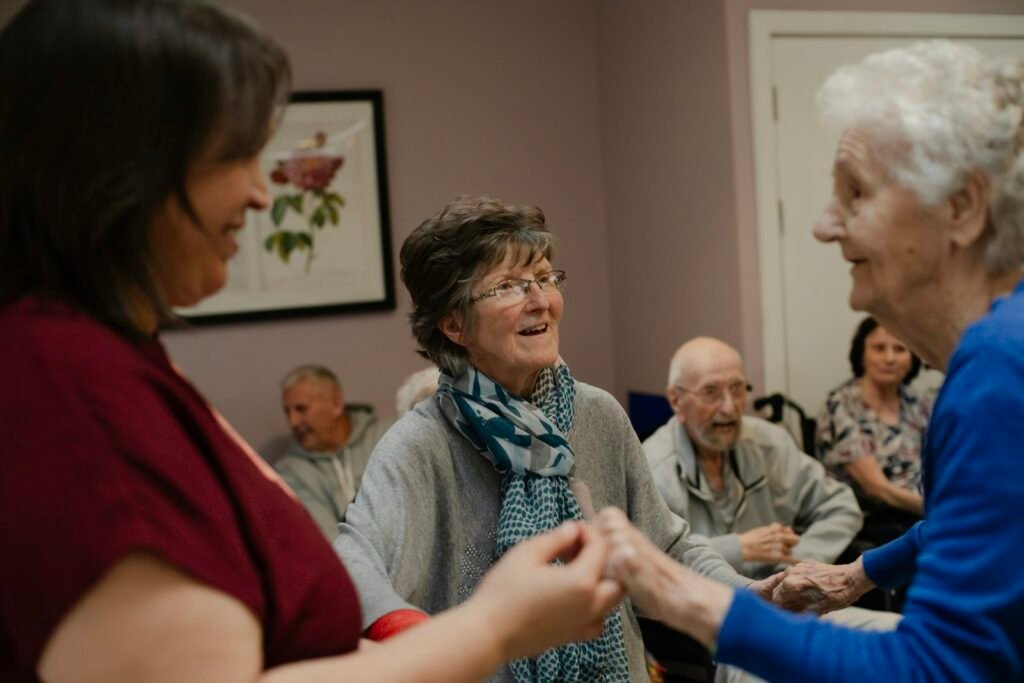
Think back over the last two weeks. How many times did you sit down across from another human being — not a phone call, not a text thread, not a comment section — and have a real conversation?
For a lot of people past 50, the honest answer is somewhere between two and zero. And it did not happen all at once.
The kids moved. You retired, or the job went remote. A couple of friends died. Your knees made the stairs at the community center feel like a project. One by one, the reasons to leave the house quietly got crossed off the list.
Nobody sends you a notification when your social life ends. It just gets quiet, and then the quiet becomes normal, and then you stop noticing.
I am going to tell you something that might sound like an overstatement. It is not. That empty calendar is one of the most well-documented modifiable risk factors for dementia that we have — and it sits on the same official list as high blood pressure and hearing loss.
Your Brain Is a Social Organ
In July 2024, the Lancet standing Commission on dementia published its updated report. This is the reference document that researchers and clinicians around the world work from, not a magazine article.
The headline finding: roughly 45 percent of dementia cases worldwide are potentially preventable by addressing 14 modifiable risk factors across the course of a life.
Fourteen factors. Hearing loss. High LDL cholesterol. Depression. Head injury. Physical inactivity. Diabetes. Smoking. High blood pressure. Obesity. Excessive alcohol. Air pollution. Vision loss. Less education. And infrequent social contact.
Infrequent social contact. Not feeling a little lonely sometimes. Not a personality trait or a character quirk. A measurable, changeable exposure, sitting on the same list as the things your doctor takes seriously enough to write a prescription for.
So why would your brain care who you talk to? Because conversation is one of the most cognitively demanding things a human being does.
Tracking someone’s tone. Reading a face. Remembering what they told you last month. Holding your own thought while they finish theirs. Adjusting what you were about to say because of something you just noticed in their expression.
That is working memory, language processing, emotional regulation, and executive function all firing at once, in real time, with no pause button. There is no puzzle app on earth that replicates it. Researchers describe it as challenging the brain to maintain efficient neural networks — use it or lose it, in the most literal sense.
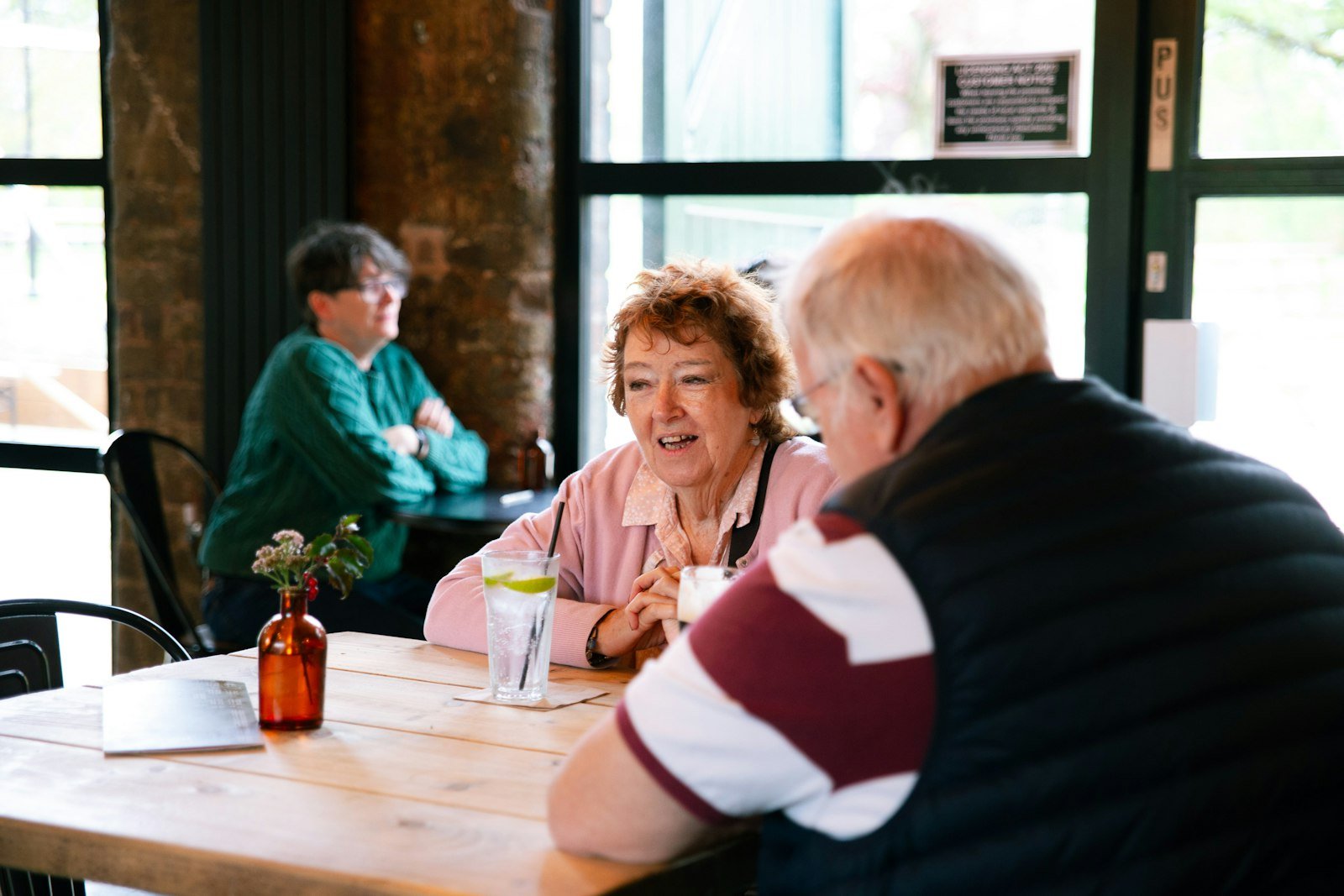
Five Years. That’s the Number.
In 2025, a study from the Rush Memory and Aging Project, led by Bryan James, was published in Alzheimer’s & Dementia, the journal of the Alzheimer’s Association.
The researchers followed 1,923 older adults who were free of dementia at the start. They measured how often participants did six ordinary social things: dining out, attending sporting events, volunteering, visiting friends or family, taking day trips, and going to group or club meetings.
Then they waited. Over the course of the study, 545 participants developed dementia and 695 developed mild cognitive impairment.
The least socially active participants developed dementia an average of five years earlier than the most socially active.
Read that again. Five years. Not five percent on some risk chart — five years of your own life, lived as yourself.
And look at what was on that activity list. Dining out. Visiting family. Volunteering. Nobody in that study was training for anything. There was no protocol, no supplement, no expensive program. They went places and saw people.
A separate meta-analysis published in Nature Mental Health in 2024, led by Martina Luchetti, pooled longitudinal data from more than 600,000 people across 21 cohorts. Loneliness was associated with roughly a 30 percent increase in the risk of all-cause dementia.
Two different research groups. Two different methods. Two genuinely different questions — social isolation and loneliness are not the same thing, and the research treats them separately. Both arrows point the same direction.

Nobody is coming to rebuild your calendar for you. That’s the bad news and the entire opportunity, in the same sentence.
Now, a fair objection, and one you should raise: doesn’t this run backwards? Maybe people withdraw socially because dementia is already quietly starting.
Researchers take that seriously. It is called reverse causation, and good studies guard against it by excluding participants who already show cognitive decline at baseline and by following people for years afterward. The Rush study did both.
That does not prove cause and effect by itself — no observational study can. But it makes they were already sick a much weaker explanation than it sounds like at first.
There is one more thing in the Rush data worth pausing on. The benefit was not limited to people who were already outgoing, and it was not about the size of your circle. It was about frequency — how often, not how many. You do not need a wide social life. You need a regular one.
Why Exercise Is the Cheat Code Here
Here is where I stop summarizing science and start being a trainer.
Look back at that list of 14 factors. Physical inactivity is on it. So is high blood pressure. So is diabetes. So is obesity. So is depression. Exercise moves every single one of those needles, which is why I have been saying for years that the gym is a brain intervention that happens to build muscle.
And it moves the social one too — if you do it in a room with other people.
Sit with that for a second. A walking group. A class at the rec center. A standing Tuesday morning with one friend at the gym. That one decision hits two separate items on the world’s most respected dementia prevention list, at the same time, for free.
And it works in the other direction too. Getting stronger is what makes the social part possible in the first place. When stairs stop being a negotiation, when you can stand for an hour at a family gathering without hunting for a chair, when a day trip does not cost you the next two days — that is when invitations stop feeling like threats.
I know what the objection is, because I have heard it a thousand times and I have felt it in my own chest: I don’t want anybody to see me like this.
I understand it better than you think. I trained under serious old-school bodybuilders starting at fourteen years old. Then my shoulders fell apart and I was gone from the gym for years. When I finally came back in my sixties, I was weaker than the beginners. I did not enjoy one minute of that.
Nobody was looking. They never are. Every person in that room is thinking about their own set, their own knees, their own reasons for being there.
Where to Actually Start When You Don’t Have a Group
If your calendar is genuinely empty, be more social is useless advice. So here is the concrete version.
- Pick one recurring thing, not many one-off things. Consistency beats intensity here exactly like it does in training. A standing Wednesday coffee outperforms three enthusiastic months of saying yes to everything.
- Attach it to something you already do. The pharmacy trip, the grocery run, church, the dog walk. New habits stick best to old habits.
- Try the public library and the parks department before you try an app. Most towns run free or nearly-free classes for adults over 50 and almost nobody knows they exist.
- Volunteer for something with a schedule. Food banks, animal shelters, schools. Obligation is underrated — it gets you out the door on the days motivation does not show up.
- Make the ask specific. We should get together sometime dies on the vine. Are you free Thursday at ten does not.
- Count phone and video calls, but do not stop there. They are far better than nothing and still not as good as a table with two chairs.
Start with one. A single recurring commitment on an empty calendar changes the shape of an entire month, and it is a much smaller ask than your brain is telling you it is.
And if the honest truth is that it is not really the calendar — if you have been feeling flat, uninterested, and not like yourself for weeks — please talk to your doctor. Depression is also on the Lancet’s list of 14. It is treatable, it is common, and it is not something you are supposed to out-discipline.
You are not too far gone and you are not too old. The participants in the Rush study averaged around 80 years old, and staying socially active was still buying them years.
The only way to start when you’re not motivated is to do it anyway. That applies to a workout. It applies just as much to picking up the phone.
Your Next Step
Want the movement side handled? The 5-Day Fit & Strong Reset is my free, beginner-friendly starting point — five days, one resistance band, no gym and no experience required. Visit SilverFitPlus.com to download it.
And if you are ready to train in a gym — which, conveniently, is also a room full of people — my 12-week Build Strong After 50 program is there waiting for you. Pick one this week, and put it on the calendar where somebody else can see it.
Sources
Livingston, G., et al. — “Dementia prevention, intervention, and care: 2024 report of the Lancet standing Commission” — The Lancet, 2024 — thelancet.com
Chen, Y., James, B. D., et al. — “Late-life social activity and subsequent risk of dementia and mild cognitive impairment” — Alzheimer’s & Dementia, 2025 — alz-journals.onlinelibrary.wiley.com
Luchetti, M., et al. — “A meta-analysis of loneliness and risk of dementia using longitudinal data from >600,000 individuals” — Nature Mental Health, 2024 — nature.com