

Every January, and every Monday, and every morning after a doctor’s appointment that scared you a little, the same thing happens. You decide this is it. You’re going to get serious. You buy the shoes, download the app, maybe even sign up for a boot camp class that promises to “melt” something off you in six weeks.
And for about eleven days, you do it. Hard. You’re sore, you’re proud, and you’re exhausted.
Then life shows up. Your knee complains. The grandkids visit. It rains. You miss two days, then five, and the guilt makes it easier to just stop altogether. By February you’re right back where you started, except now you’ve got one more piece of evidence that you’re “just not an exercise person.”
I want to tell you something that took me decades to learn: the problem was never your willpower. The problem was the plan. You were sold intensity when what you needed was consistency.
I started lifting at 14. I trained with old-school bodybuilders who believed that if you could walk out of the gym, you hadn’t worked hard enough. That mindset built muscle when I was young. It also helped wreck both of my shoulders by my early 40s: arthritis on both sides, torn rotator cuffs, and years when I didn’t train at all.
When I finally came back in my 60s, fighting sarcopenia and a body that didn’t bounce back like it used to, I had to throw out almost everything I thought I knew about “going hard.” What brought me back wasn’t a brutal program. It was showing up, using pain-free angles, a little bit at a time, over and over again.
Why “Going All-In” Keeps Sending You Back to the Couch
Here’s what nobody tells you about high-intensity starts after 50: they’re built for people who are already in shape. If you’ve been sedentary for years, your tendons, joints, and connective tissue adapt far more slowly than your muscles do. Your enthusiasm can outrun your body’s ability to recover by a mile.
So you go hard, you get hurt or wiped out, and you quit. That isn’t a character flaw. It’s the predictable result of a bad plan.
There’s a mental cost, too. When every workout is an hour of misery, your brain learns one thing: exercise equals suffering. Every time you think about the next session, you feel dread instead of momentum. No wonder it’s hard to get off the couch.
Consistency flips that. A 15-minute session you can actually finish, one that leaves you feeling better than when you started, teaches your brain that exercise is something you can do, not something that gets done to you. That shift matters more than any single workout ever will.
And the bar you’re trying to clear is lower than you think. In a 2022 systematic review and meta-analysis published in the British Journal of Sports Medicine, Haruki Momma and colleagues pooled 16 studies and found that 30 to 60 minutes of muscle-strengthening activity per week was associated with a 10–20% lower risk of death from all causes, cardiovascular disease, and cancer, along with a lower risk of developing diabetes. They found no clear evidence that going beyond about an hour a week added more benefit.
Read that again. Thirty to sixty minutes. Per week, not per day. That’s two or three short sessions. You don’t need to suffer. You need to show up.
Small Doses, Done Often, Add Up Faster Than You’d Think
If you’ve ever thought, “What’s the point of ten minutes? That won’t do anything,” this section is for you.
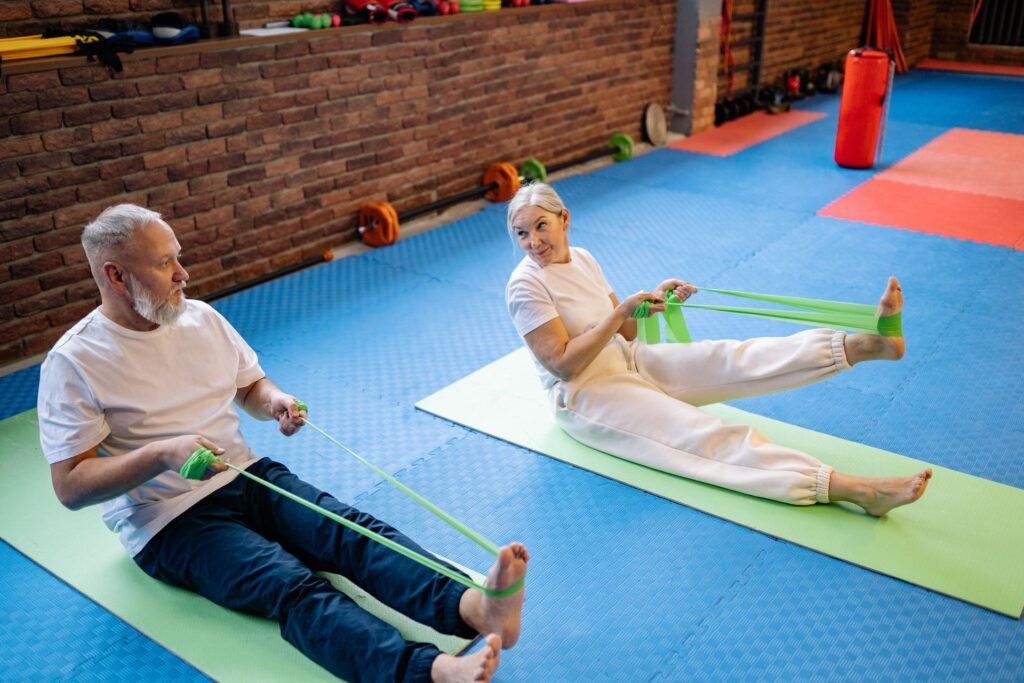
Researchers in Japan and Australia have been studying how little exercise the body needs in order to respond, as long as it happens regularly. In a 2022 study in the Scandinavian Journal of Medicine & Science in Sports, Yoshida and colleagues compared people who did a handful of slow, lowering-phase (eccentric) arm contractions every day, five days a week, against people who did a much larger batch all at once, one day a week. The little-bit-almost-every-day group came out ahead on strength gains.
To be fair, those participants were young, healthy adults, and the study looked at one muscle group in a lab. It isn’t a full workout program. But the principle it points to matches what I’ve seen in more than 40 years of training: your body responds to frequent signals.
A small stimulus, repeated, tells your muscles, “This matters. Keep this around.” One giant effort followed by six days of nothing sends a much weaker message.
That’s great news if you’re starting from zero. It means your 10-minute morning routine isn’t a consolation prize. It may actually be the smarter strategy.
Frequency also protects your joints. Short sessions mean less accumulated fatigue, which means better form, which means fewer of the injuries that sidelined me for years. When you’re not grinding out rep number 15 on a tired shoulder, you’re not setting yourself up for six months of physical therapy.
There’s one more hidden advantage. Short, frequent sessions are easy to fit around real life. You don’t need to find a free hour, drive to a gym, or change clothes. You just need ten minutes and a little floor space. The easier something is to start, the more often it actually happens.

How to Build a Routine You’ll Still Be Doing in December
Knowing that consistency matters is one thing. Pulling it off on a rainy Tuesday when your back is stiff is another. Here’s the framework I use with the beginners I work with.
A 2010 study by Phillippa Lally and colleagues at University College London, published in the European Journal of Social Psychology, followed 96 people as they tried to build a new daily habit. On average, it took about 66 days for the behavior to feel automatic, with a huge range from 18 days to an estimated 254. And here’s the part I love: missing a single day didn’t meaningfully derail the process.
So stop treating one missed workout as a failure. It’s one Tuesday. Pick it back up on Wednesday.
Here’s how to set yourself up to win:
- Shrink the workout until it’s almost too easy. Ten minutes. Three exercises. If you can’t imagine skipping it, it’s the right size.
- Attach it to something you already do. After your morning coffee. Before your evening shower. The old habit becomes the trigger for the new one.
- Use the same time and place every day. Your brain loves context: same chair, same corner of the living room, same time on the clock.
- Track showing up, not performance. Put a check mark on the calendar each time you do it. Don’t record how heavy or how many. Just that you did it.
- Plan your “bad day” version in advance. On days you’re tired or sore, do five minutes of the easiest moves. The streak survives, and so does the habit.
- Only add more after three or four weeks of steady showing up. A few extra minutes, an extra set, a slightly tougher band. Earn the upgrade.
Notice that nothing on that list is about pushing harder. Every item is about making it easier to show up again tomorrow. That’s the whole game.
You don’t need a perfect workout. You need a workout you’ll do again tomorrow — and the day after that.
What to Do on the Days You Don’t Feel Like It
Let me be straight with you: there will be days you don’t want to. Lots of them. Motivation is a lousy employee. It shows up late, leaves early, and calls in sick whenever it rains.
That’s why my motto has always been simple: the only way to start when you’re not motivated is to do it anyway.
Not the full workout. Not a heroic effort. Just start. Put on your shoes. Grab the band. Do one set of sit-to-stands from a kitchen chair. Most days, once you’ve started, you’ll finish the short version. And on the day when you really do stop after one set, you still showed up. The check mark still goes on the calendar.
Here’s what happens over months when you train this way. The dread fades. Getting up off the floor gets easier. Carrying groceries stops being a two-trip job. Your doctor notices your numbers moving in the right direction.
Somewhere along the line, you realize you’ve become someone who exercises. Not because you finally found the willpower, but because you stopped depending on it.
Compare that to the all-in approach: six intense weeks, an injury or burnout, then nothing for six months. Add it up over a year and the “slow” approach wins by a landslide. Every time.
I’m living proof. I didn’t come back from two bad shoulders and sarcopenia with one heroic effort. I came back one short, pain-free session at a time. I’m stronger now than I was a decade ago, and it’s because I finally stopped trying to be a hero and started trying to be consistent.
Your Next Step Starts Small
If you’re ready to stop starting over, start small. You don’t need a gym, a trainer, or a perfect plan. You need a simple routine you can repeat.
That’s exactly why I created the 5-Day Fit & Strong Reset. It’s a free, beginner-friendly PDF built for people starting right where you are: short sessions, pain-free movements, and all you need is a resistance band. Five days to prove to yourself that you can show up. Visit SilverFitPlus.com to grab your free copy and take your first small step today.
Then do it again tomorrow.
Sources
Momma H, Kawakami R, Honda T, Sawada SS — “Muscle-strengthening activities are associated with lower risk and mortality in major non-communicable diseases: a systematic review and meta-analysis of cohort studies” — British Journal of Sports Medicine, 2022 — https://pubmed.ncbi.nlm.nih.gov/35228201/
Yoshida R, et al. — “Greater effects by performing a small number of eccentric contractions daily than a larger number of them once a week” — Scandinavian Journal of Medicine & Science in Sports, 2022 — https://onlinelibrary.wiley.com/doi/10.1111/sms.14220
Lally P, van Jaarsveld CHM, Potts HWW, Wardle J — “How are habits formed: Modelling habit formation in the real world” — European Journal of Social Psychology, 2010 — https://onlinelibrary.wiley.com/doi/10.1002/ejsp.674